
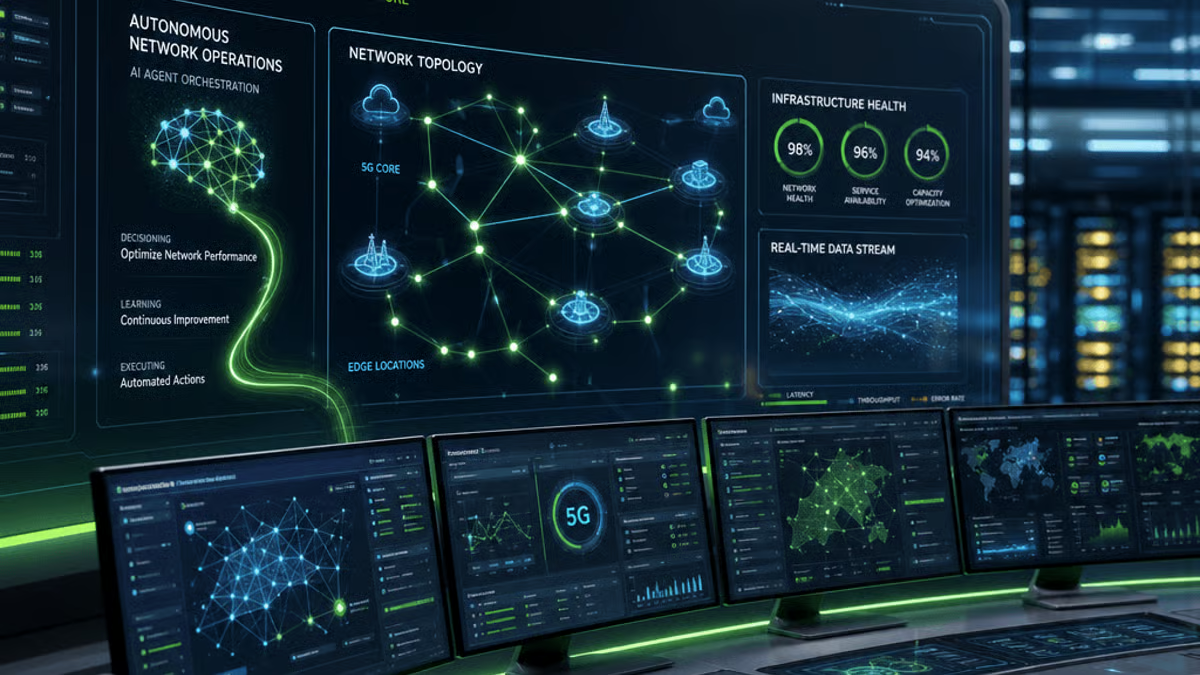
NVIDIA just made a major play for the telecom sector with autonomous AI agents that run network operations around the clock without human intervention. Announced at DTW Ignite 2026, the move signals a strategic shift from task-based automation to full operational autonomy—putting the chipmaker directly into the enterprise AI infrastructure game. For telecom operators already seeing returns from generative AI in customer care and network management, this represents the next evolution: AI that doesn’t just assist, but operates independently.
NVIDIA is betting big that telecom operators are ready to hand over the keys to their networks. The company’s new autonomous AI agent platform, unveiled at DTW Ignite 2026, promises to transform how telecom infrastructure runs—replacing human-directed automation with AI that makes independent decisions 24/7.
According to NVIDIA’s announcement, telecom operators have already seen “remarkable returns” from generative AI deployments in network management and customer care. But those gains have been limited to task-based automation—systems that speed up predetermined steps while people still manually correlate insights and direct next actions. NVIDIA’s pitch? “Automation is no longer the finish line, it’s the launchpad to autonomy.”
The distinction matters. Task automation handles repetitive work faster. Autonomous agents make decisions, adapt to changing conditions, and orchestrate complex operations without waiting for human approval. For telecom operators managing millions of network nodes and customer interactions simultaneously, that difference could be worth billions in operational efficiency.
NVIDIA’s timing aligns with a broader enterprise AI shift. Companies across industries are moving from AI copilots that assist workers to AI agents that operate independently. Microsoft, Google, and OpenAI have all launched agent frameworks in recent months, but NVIDIA’s approach targets a specific vertical with custom infrastructure requirements.
Telecom networks present unique challenges for autonomous AI. Unlike customer service chatbots or code generation tools, network management agents need to process massive real-time data streams, predict equipment failures before they happen, and orchestrate failovers across geographically distributed infrastructure. They also need to explain their decisions to human operators and regulators—a trust requirement that’s slowed AI adoption in mission-critical systems.
NVIDIA hasn’t disclosed technical specifics about how its agents handle these challenges, but the company’s track record in AI infrastructure gives it credibility. Its GPUs already power the training and inference for most large language models, and its AI Enterprise software suite provides the frameworks telecom operators would need to deploy agents safely. The question is whether operators are ready to trust AI with autonomous decision-making in live production networks.
Early generative AI deployments in telecom focused on lower-risk applications—summarizing customer service calls, generating network configuration templates, automating routine maintenance tickets. Those use cases delivered value without risking network outages or service disruptions. Autonomous agents that independently manage network traffic, allocate resources, and respond to security threats represent a much bigger leap in operational trust.
But the economic pressure to adopt is mounting. Telecom operators face rising infrastructure costs as 5G deployments expand and data traffic grows exponentially. Labor costs for skilled network engineers continue climbing while talent becomes harder to find. AI agents that can handle tier-1 and tier-2 operations work without breaks, don’t require training on new equipment, and scale instantly across global deployments.
NVIDIA’s announcement positions the company as more than just a chip supplier—it’s becoming an enterprise AI platform provider competing with cloud giants. While Amazon Web Services, Microsoft Azure, and Google Cloud offer AI agent frameworks, NVIDIA brings deep domain expertise in high-performance computing and real-time inference that telecom applications demand.
The broader implications extend beyond telecom. If NVIDIA can prove autonomous agents work reliably in network operations—one of the most demanding enterprise environments—it opens the door to similar deployments in energy grids, manufacturing plants, logistics networks, and financial systems. Every industry with complex infrastructure and 24/7 operational requirements becomes a potential customer.
What remains unclear is the business model. NVIDIA could license the agent platform directly to telecom operators, bundle it with its AI Enterprise software, or partner with network equipment vendors to embed the technology in infrastructure gear. The company’s historical preference for platform plays over vertical solutions suggests a licensing approach that lets operators customize agents for their specific networks.
Competition in the autonomous agent space is intensifying fast. Anthropic recently launched Claude agents for enterprise workflows, OpenAI is testing agents in ChatGPT Enterprise, and Google’s Vertex AI includes agent-building tools. But none have announced vertical-specific platforms for telecom operations—giving NVIDIA a first-mover advantage in a massive market.
The DTW Ignite timing also matters strategically. The event brings together telecom executives making purchasing decisions for next-generation infrastructure. By demonstrating autonomous agents at the industry’s flagship conference, NVIDIA positions itself early in budget cycles and technology roadmaps. Expect partnerships with major equipment vendors and early deployments with tier-1 carriers to follow in coming months.
NVIDIA’s autonomous agent push represents a calculated bet that enterprise AI is ready to move from assistance to autonomy. For telecom operators, the promise of 24/7 self-managing networks addresses real operational pain points—but only if the technology proves trustworthy at scale. The company’s strength in AI infrastructure gives it a credible foundation, but turning that into production deployments across live telecom networks will require proving reliability that goes beyond research demos. If NVIDIA succeeds, it doesn’t just expand its telecom business—it establishes the blueprint for autonomous agents across every industry with critical infrastructure. That’s a much bigger prize than chip sales alone.










Leave a Reply