
- ■
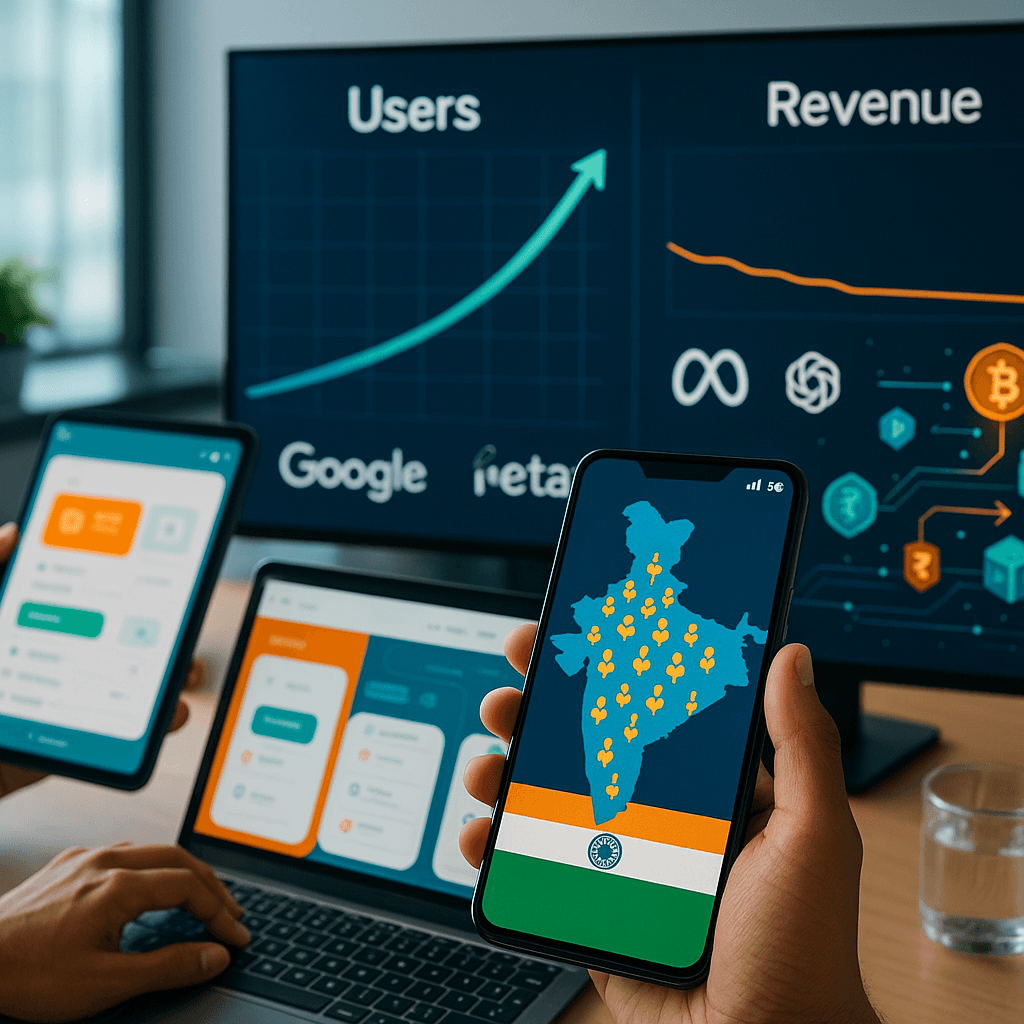
India’s non-gaming app market is booming with streaming and AI leading growth, but global platforms capture most revenue while local startups struggle
- ■
Spending per user in India lags significantly behind global peers despite massive download numbers and engagement metrics
- ■
Meta’s Instagram and Facebook dominate social, while Google One and OpenAI’s ChatGPT see surging adoption in AI and cloud storage
- ■
JioHotstar and other local streaming platforms face mounting pressure from deep-pocketed international competitors
India’s app economy is exploding, but there’s a catch that’s keeping local entrepreneurs up at night. While downloads and engagement soar across streaming and AI apps, Google and Meta are walking away with the lion’s share of revenue, leaving homegrown platforms scrambling for scraps. New data reveals India’s average spending per user remains stubbornly low compared to Western markets, even as the country becomes the world’s fastest-growing app ecosystem. The disconnect is reshaping how global tech giants approach the world’s most populous nation.
The numbers tell a tale of two markets. India just became the world’s largest app download market, but when it comes to actual revenue, it barely cracks the top ten. That paradox is playing out in real-time as Meta and Google double down on user acquisition while local competitors struggle to monetize their home turf.
Streaming platforms are leading the charge. JioHotstar, the merged entity combining Reliance Jio’s reach with Disney’s content library, thought it had the winning formula for India’s entertainment-hungry millions. But the platform is discovering what every local player already knows: getting Indians to pay for content is brutally hard when global competitors are willing to subsidize growth for years.
Meta’s strategy reveals the playbook. Instagram and Facebook aren’t just dominant in India—they’re practically ubiquitous. The company’s FreeReels feature, which lets users watch short-form video without eating into data caps, has turned into a master class in emerging market penetration. Meta loses money on every subsidized gigabyte but gains something more valuable: an unshakeable position in the daily habits of 500 million Indians.
The AI surge is following a similar pattern. OpenAI’s ChatGPT saw downloads in India jump dramatically over the past quarter, making the country one of the chatbot’s fastest-growing markets. Indians are experimenting with AI for everything from exam prep to business planning, but most are sticking with free tiers. The paid conversion rate remains a fraction of what OpenAI sees in the US or Europe.
Google One, the company’s cloud storage subscription service, is making modest inroads by bundling VPN access and photo editing tools that appeal to India’s growing creator economy. But even Google is learning to play the long game, offering rock-bottom pricing that would never fly in mature markets.
The spending gap is staggering. While an average American app user might spend $30-40 monthly across subscriptions, their Indian counterpart barely hits $3-4. That ten-fold difference isn’t just about income disparities—it reflects a fundamental resistance to paying for digital services in a market where free alternatives have always existed.
Local startups are caught in a vise. They can’t outspend Google and Meta on user acquisition, and they can’t afford to give away services for free indefinitely. Venture capital that once flowed freely into Indian consumer apps has largely dried up, with investors demanding profitability over growth. Meanwhile, the giants can treat India as a strategic long-term play, banking on the day when rising incomes finally unlock serious monetization.
The non-gaming app focus is deliberate. After India banned PUBG Mobile and dozens of Chinese gaming apps in 2020, the mobile gaming landscape fragmented. Streaming, productivity, and AI apps rushed to fill the engagement vacuum, but the revenue didn’t follow. Users who spent hours daily on entertainment apps would balk at a 99-rupee monthly subscription.
JioHotstar represents the best hope for a local champion, backed by Reliance’s deep pockets and political connections. But even Mukesh Ambani’s billions can only subsidize so much. The platform needs to prove it can convert free users to paying subscribers at scale, something no Indian streaming service has truly cracked.
What makes this moment critical is timing. India’s digital infrastructure is finally catching up to its ambitions. 5G networks are expanding rapidly, smartphone prices keep falling, and a generation of young Indians expects app-based services for everything. The market is ready to explode—the question is who’ll be left standing when it does.
Google and Meta are betting they can wait out local competitors, using their global profits to subsidize Indian operations until the market matures. It’s a strategy that’s worked in other emerging markets, from Indonesia to Brazil. But India’s scale and complexity make it different. Cultural fragmentation, language diversity, and regional preferences create opportunities for nimble local players who understand nuances the giants might miss.
The AI wave adds another wrinkle. While ChatGPT dominates English-language queries, there’s massive white space in vernacular AI assistants. A startup that cracks Hindi, Tamil, or Bengali conversational AI could build a moat that even OpenAI would struggle to breach. But developing those models requires capital and compute that most Indian startups simply don’t have.
For now, the pattern holds: India supplies the users, Silicon Valley supplies the platforms, and the revenue flows west. Local founders watch their user numbers climb while their bank accounts don’t, knowing they’re building on someone else’s infrastructure and living on borrowed time.
India’s app economy is at an inflection point that will define the next decade of its digital future. The market has the users, the engagement, and the infrastructure—everything except the revenue model that works at scale. Global platforms are playing chess while local startups play checkers, leveraging infinite patience and deep pockets to outlast homegrown competition. But betting against Indian entrepreneurs has historically been a mistake. The companies that figure out hyper-local monetization, vernacular AI, or culturally specific use cases could still flip the script. For now, though, the boom everyone’s celebrating is making Google, Meta, and OpenAI rich while leaving India’s startup ecosystem wondering when their turn will come.









Leave a Reply