
- ■
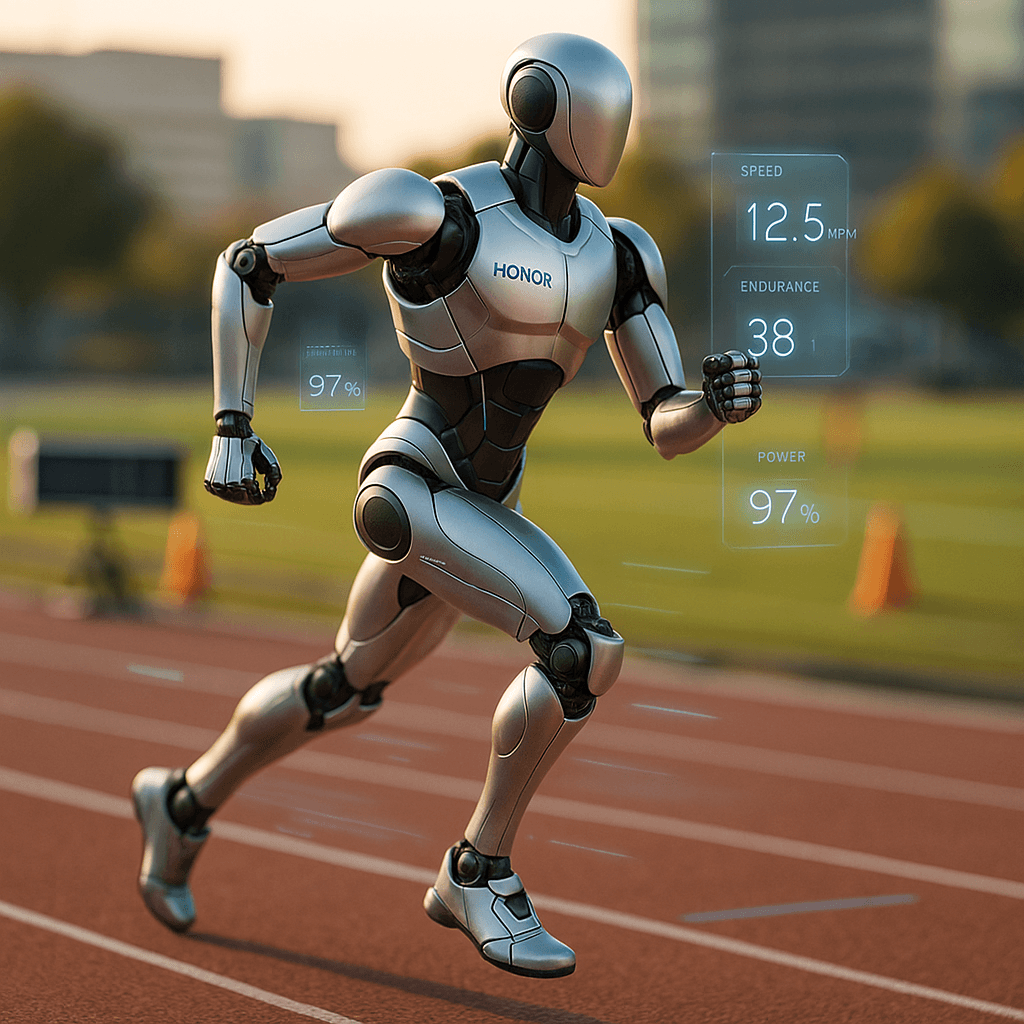
Honor’s autonomous humanoid robot completed a half-marathon in 50:26, beating the human record of approximately 57:30 by seven minutes
- ■
The achievement represents a major breakthrough in bipedal robot endurance and autonomous navigation over long distances
- ■
Honor joins Tesla, Boston Dynamics, and Chinese competitors in the intensifying race to develop practical humanoid robotics
- ■
The demonstration highlights rapid advances in battery efficiency, motion control, and AI-powered balance systems
Honor, the Chinese smartphone maker, just pushed humanoid robotics into uncharted territory. The company’s autonomous robot completed a half-marathon in 50 minutes and 26 seconds – crushing the human world record by a full seven minutes. The demonstration in China marks a significant leap in bipedal locomotion and endurance capabilities for walking robots, raising fresh questions about where human athletic supremacy ends and machine efficiency begins.
Honor, best known for smartphones and consumer electronics, just delivered the robotics world’s most unexpected flex. The company’s humanoid robot completed a regulation half-marathon course in China in 50 minutes and 26 seconds, according to reports from Wired. That’s seven minutes faster than the human world record of roughly 57 minutes and 30 seconds, set by elite distance runners under optimal conditions.
The achievement isn’t just about speed. Running 13.1 miles autonomously demands sustained power management, real-time terrain adaptation, and balance algorithms that can handle fatigue-equivalent system degradation over nearly an hour of continuous operation. While wheeled robots have long outpaced human runners, bipedal machines face the same gravitational and momentum challenges that make human marathons grueling tests of endurance.
Honor hasn’t released detailed specs on the robot’s design, but the implications ripple across the robotics industry. Tesla’s Optimus humanoid has demonstrated warehouse tasks and basic walking. Boston Dynamics Atlas can parkour and dance but hasn’t attempted endurance events. Chinese robotics firms have been aggressively iterating on humanoid designs, and Honor’s entry suggests the smartphone wars are spilling into physical AI.
The technical challenge centers on energy density and gait efficiency. Bipedal locomotion wastes energy with every step – humans evolved remarkable efficiency, but robots typically burn through batteries maintaining balance alone. A 50-minute continuous run implies either breakthrough battery technology, exceptional motion optimization, or both. The fact that Honor pulled this off autonomously, without tethered power or human intervention, makes it a legitimate engineering milestone.
Competitive context matters here. Tesla CEO Elon Musk has repeatedly claimed Optimus will become the company’s most valuable product, envisioning factories full of humanoid workers. China’s Unitree and Xiaomi have both unveiled sub-$20,000 humanoid prototypes aimed at consumer and industrial markets. Honor’s marathon stunt positions the company as a credible player in a space dominated by robotics specialists and deep-pocketed automakers.
The business calculus is shifting fast. Humanoid robots were science fiction five years ago, niche research projects three years ago, and venture-funded moonshots last year. Now they’re product demos at trade shows and marathon courses. Honor’s move feels like a brand play – the kind of headline-grabbing demonstration that cements credibility before launching commercial units. It’s also a talent signal, advertising engineering chops to AI researchers weighing offers from ByteDance, Baidu, or Alibaba.
What the demo doesn’t answer: Can the robot navigate crowded sidewalks? Climb stairs after 10 miles of running? Recover from a stumble at mile 8? Marathon records sound impressive, but practical robotics is about reliability under unpredictable conditions, not controlled course speed runs. Still, you can’t dismiss a robot that just outran every human who’s ever lived over 13.1 miles.
The achievement also highlights China’s aggressive push into embodied AI. While Western labs focus on large language models and cloud intelligence, Chinese firms are pouring capital into physical robots with real-world applications. Factory automation, elderly care, and logistics all benefit more from robots that can walk, lift, and navigate than from chatbots that write poetry. Honor’s marathon bot might be a publicity stunt, but it’s a stunt that required solving hard problems in power, control, and autonomy.
Industry watchers will scrutinize the verification process. Was this a sanctioned course? Independent timing? Video evidence of the full run? Robotics demos have a checkered history – Boston Dynamics faced skepticism over edited videos, and Tesla’s early Optimus reveal used a human in a suit. Honor will need transparent documentation if this record is going to withstand technical scrutiny and become a reference point for future bipedal endurance benchmarks.
The immediate impact is perceptual. Honor just vaulted from smartphone contender to robotics innovator in the span of a 50-minute run. Whether that translates to commercial humanoid products or remains a one-off moonshot depends on what Honor reveals next. But the company clearly isn’t content competing on camera specs and 5G modems anymore.
Honor’s 50-minute half-marathon isn’t just a robotics milestone – it’s a signal that the humanoid race is accelerating beyond research labs into real-world performance benchmarks. Whether this becomes a commercial product or remains an engineering flex, the message is clear: bipedal robots are evolving faster than most predicted, and the companies building them aren’t all the usual suspects. The next chapter will reveal whether Honor can translate marathon endurance into practical applications, or if this was just the world’s most expensive marketing stunt. Either way, human runners just lost another record to the machines.








Leave a Reply