
A new Mac application called Osaurus is taking a different approach to AI assistants by letting users switch between local and cloud models while keeping their memory, files, and tools stored locally on their own hardware. The hybrid approach addresses growing privacy concerns around cloud-based AI tools while still offering access to powerful remote models when needed, according to TechCrunch.
Mac users now have a new option for AI assistance that doesn’t force them to choose between privacy and power. Osaurus, a newly launched Mac application, combines both local and cloud-based AI models in a single interface while keeping user data firmly planted on their own hardware.
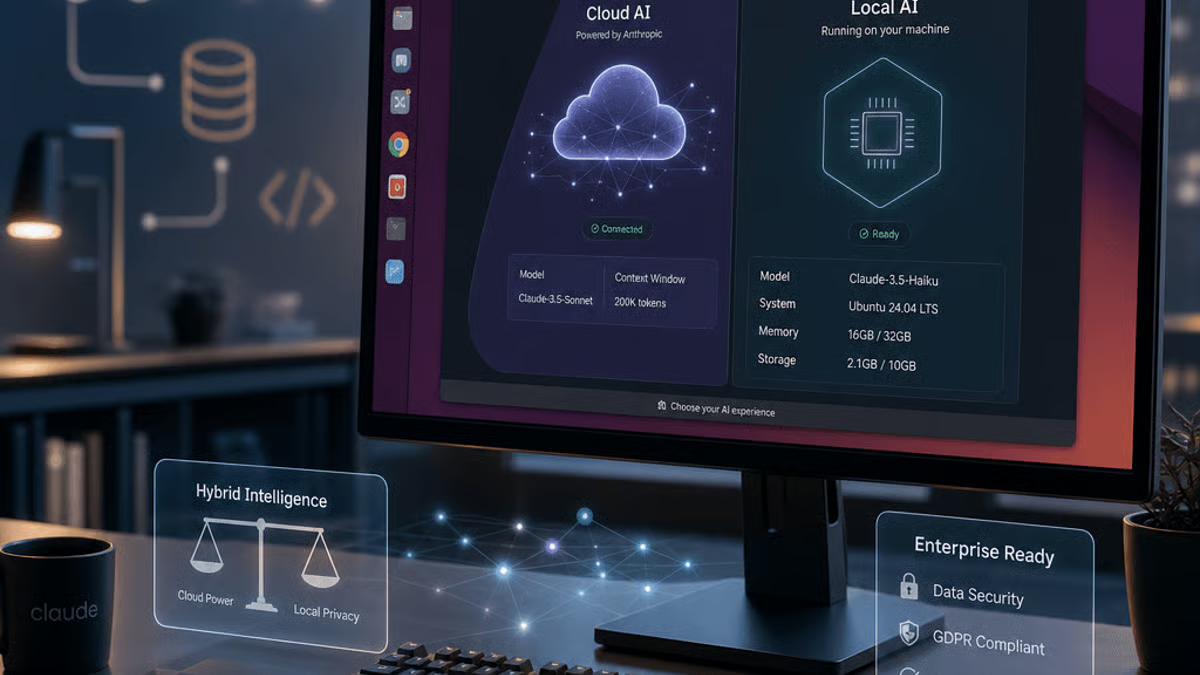
The app addresses a growing tension in the AI assistant market. Cloud-based tools like ChatGPT and Claude offer cutting-edge capabilities but require sending data to remote servers. Local AI models provide privacy but often lack the power of their cloud-based counterparts. Osaurus attempts to split the difference by supporting both approaches within one application.
What sets the app apart is its architecture around data storage. While users can tap into cloud AI models when they need extra processing power, their conversation history, files, and custom tools stay on their Mac rather than syncing to external servers. This hybrid model gives users flexibility without sacrificing control over sensitive information.
The timing is notable. Privacy concerns around AI tools have intensified as these systems become more deeply integrated into professional workflows. Companies have banned certain AI assistants over data security worries, while individual users have grown wary of how much personal information they’re feeding into cloud systems.
Local AI models have improved dramatically over the past year, making on-device processing more viable. Apple’s recent silicon chips have accelerated this trend by building neural processing capabilities directly into Mac hardware. But cloud models still maintain significant advantages for complex tasks that require massive compute resources.
Osaurus appears designed for users who want the best of both worlds – the privacy of local processing for sensitive work and the option to leverage cloud models for demanding tasks. The approach could appeal particularly to professionals handling confidential information who still need access to state-of-the-art AI capabilities.
The Mac-specific focus also makes sense given Apple’s emphasis on privacy and its growing AI ambitions. The company has positioned on-device intelligence as a key differentiator, though it too is exploring hybrid approaches that combine local and cloud processing.
What remains to be seen is how smoothly Osaurus can balance these two modes in practice. Users will need clear guidance on when data stays local versus when it gets sent to cloud providers. The app will also need to make switching between local and cloud models seamless enough that users don’t abandon the privacy features out of convenience.
The launch comes as the Mac AI ecosystem continues to expand rapidly. Developers are racing to build tools that take advantage of Apple’s silicon and the growing capabilities of models that can run entirely on-device. At the same time, users are demanding more transparency and control over how their data gets used in AI systems.
For privacy-conscious Mac users who’ve been waiting for a middle ground between fully local and fully cloud-based AI tools, Osaurus represents an intriguing option. The app’s success will likely depend on execution – whether it can deliver on the promise of seamless hybrid AI without compromising either privacy or capability.
Osaurus enters a Mac AI market that’s rapidly evolving around the tension between privacy and performance. By letting users maintain local control over their data while still accessing cloud models when needed, the app offers a compromise that could resonate with security-conscious professionals and power users alike. The real test will be whether the hybrid approach works smoothly enough in practice to justify the added complexity over simpler, single-mode alternatives.






Leave a Reply