
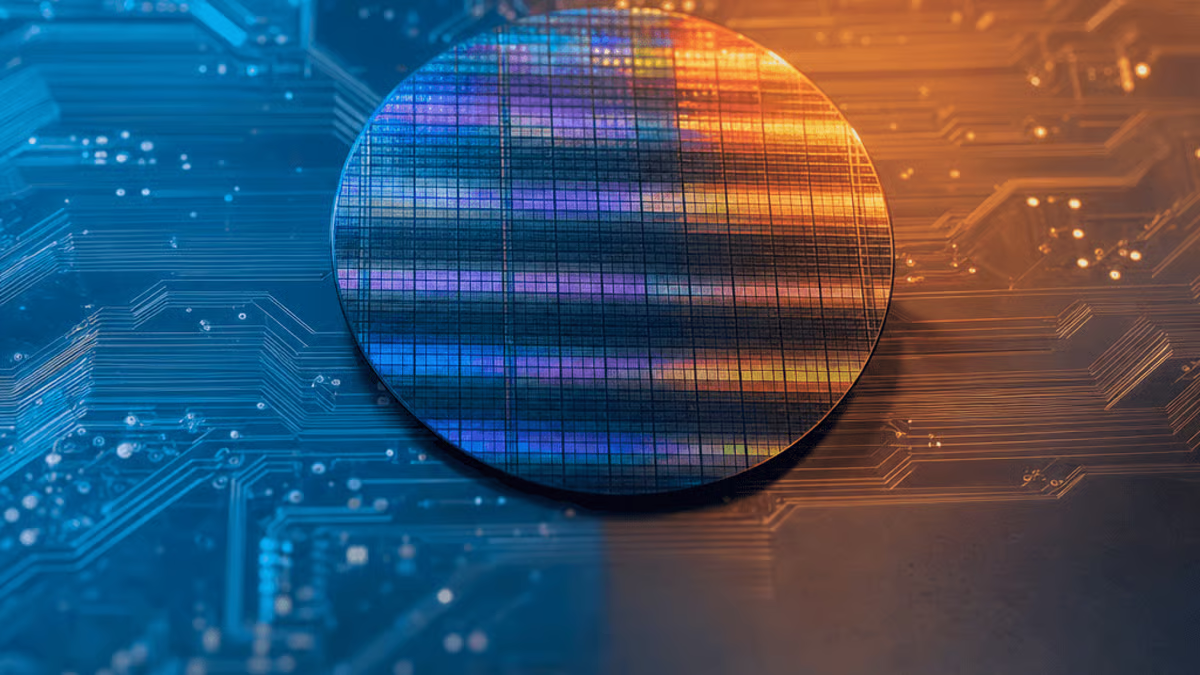
CNBC’s Jim Cramer is making a contrarian call on one of the tech industry’s most contentious geopolitical flashpoints. The Mad Money host says Nvidia should be allowed to sell AI chips in China, arguing that keeping Chinese companies dependent on American semiconductor technology serves US interests better than forcing Beijing to build domestic alternatives. It’s a strategic gambit that flips the export control narrative on its head, coming as Washington tightens restrictions on advanced chip sales to China.
Nvidia finds itself at the center of a geopolitical chess match, and Jim Cramer just made a bold move. The CNBC host is pushing back against the prevailing Washington consensus, arguing that allowing Nvidia to supply AI chips to China actually strengthens America’s technological position rather than weakening it.
The logic is surprisingly pragmatic. By maintaining Chinese access to Nvidia’s cutting-edge H100 and future Blackwell chips, even in export-compliant versions, Beijing’s AI companies remain tethered to American innovation. Cut off that supply completely, Cramer suggests, and you accelerate China’s timeline for building truly independent semiconductor capabilities. It’s the classic strategic question: is it better to be an indispensable supplier or a banned competitor?
This puts Cramer at odds with the Biden administration’s approach to chip export controls. Over the past two years, the Commerce Department has steadily tightened restrictions on advanced AI chip sales to China, citing national security concerns about military applications and surveillance technology. The October 2023 rules expanded beyond just chip sales to include restrictions on chip design software and manufacturing equipment, aiming to create what officials called a “small yard, high fence” around critical technologies.
But Cramer’s argument taps into a debate that’s been simmering among policy experts and tech executives. Former Google CEO Eric Schmidt has made similar points, suggesting that total isolation might backfire by eliminating American visibility into Chinese AI development while spurring Beijing to invest even more heavily in self-sufficiency. The semiconductor industry has long warned that overly broad restrictions could simply shift market share to foreign competitors without meaningfully slowing China’s technological progress.
Nvidia has already been navigating this minefield with surgical precision. The company developed China-specific chips like the A800 and H800 that comply with US performance restrictions while still serving the massive Chinese data center market. Those workarounds generated billions in revenue before new rules closed those loopholes in late 2023. CEO Jensen Huang has publicly expressed frustration with the restrictions, noting that they cost Nvidia access to one of the world’s largest AI markets.
The financial stakes are substantial. China represented roughly 20-25% of Nvidia’s data center revenue before the most recent restrictions kicked in. That’s tens of billions in annual sales hanging in the balance. Yet Cramer insists the stock will thrive either way, pointing to explosive demand from US hyperscalers, enterprise AI adoption, and international markets that more than compensate for any China losses.
Wall Street seems to agree with that assessment, if not necessarily Cramer’s policy prescription. Nvidia shares have surged over 200% in the past year as the AI boom shows no signs of slowing. Microsoft, Amazon, Google, and Meta are all racing to build out AI infrastructure, creating what analysts describe as a multi-year supercycle for data center chips. The constraint isn’t demand but Nvidia’s ability to manufacture enough chips to meet orders.
But the geopolitical dimension cuts deeper than quarterly earnings. China has made semiconductor self-sufficiency a top national priority, funneling over $150 billion into domestic chip development through initiatives like the Big Fund. Companies like SMIC are pushing the boundaries of what they can achieve with restricted access to cutting-edge lithography equipment. Huawei shocked the industry last year by releasing a 7nm chip that wasn’t supposed to be possible under current export controls.
Cramer’s bet is that maintaining commercial ties slows that independence timeline. If Chinese AI labs can still buy export-compliant Nvidia chips, even with performance limitations, there’s less urgency to build entirely domestic alternatives. Sever those ties completely, and you remove any remaining friction to China going all-in on indigenous innovation.
The counterargument from national security hawks is that any advanced chip sales give China capabilities that could be weaponized for surveillance, military AI, or other applications that threaten US interests. They point to companies like SenseTime and Megvii, whose facial recognition systems power China’s surveillance state, as examples of why even commercial AI development poses security risks.
What makes this debate particularly thorny is that there’s no clean answer. Export controls are a blunt instrument trying to solve a multidimensional problem. Too restrictive, and you accelerate Chinese self-sufficiency while hurting American companies. Too permissive, and you enable technological capabilities that could come back to haunt you. The sweet spot, if it exists, requires calibrating restrictions to slow China’s military AI development without completely decoupling the commercial technology ecosystems.
Nvidia leadership has largely stayed out of the public policy fight, focusing instead on compliance and product development. But behind the scenes, the company has lobbied for what it calls a “nuanced” approach that allows commercial AI sales while restricting military and surveillance applications. That’s easier said than done when the same chips power both ChatGPT and facial recognition systems.
For investors, Cramer’s take offers a certain reassurance amid the policy uncertainty. If Nvidia can indeed thrive whether China sales continue or evaporate, it removes a major overhang on the stock. The company’s dominance in AI infrastructure, its CUDA software moat, and the sheer scale of global AI investment create multiple paths to growth that don’t depend on Beijing’s goodwill or Washington’s export licenses.
But the strategic question Cramer raises extends beyond any single company’s fortunes. It gets at the fundamental challenge of maintaining technological leadership in an era of great power competition. Do you maximize short-term security by restricting all advanced technology flows, or do you play a longer game of keeping competitors dependent on your innovation ecosystem? The answer will shape not just chip policy but the entire trajectory of US-China tech relations for the next decade.
Cramer’s contrarian take on Nvidia and China cuts to the heart of the strategic dilemma facing US tech policy. There’s a real tension between protecting national security in the present and maintaining technological leverage for the future. Whether you buy his argument or not, the underlying truth is harder to dispute: export controls are forcing American policymakers to make complex bets about how China will respond, what technologies matter most, and whether isolation or engagement better serves long-term interests. For Nvidia, the company seems positioned to win either way. For the broader US-China tech competition, the consequences of getting this balance wrong could reshape the global innovation landscape for a generation.









Leave a Reply