
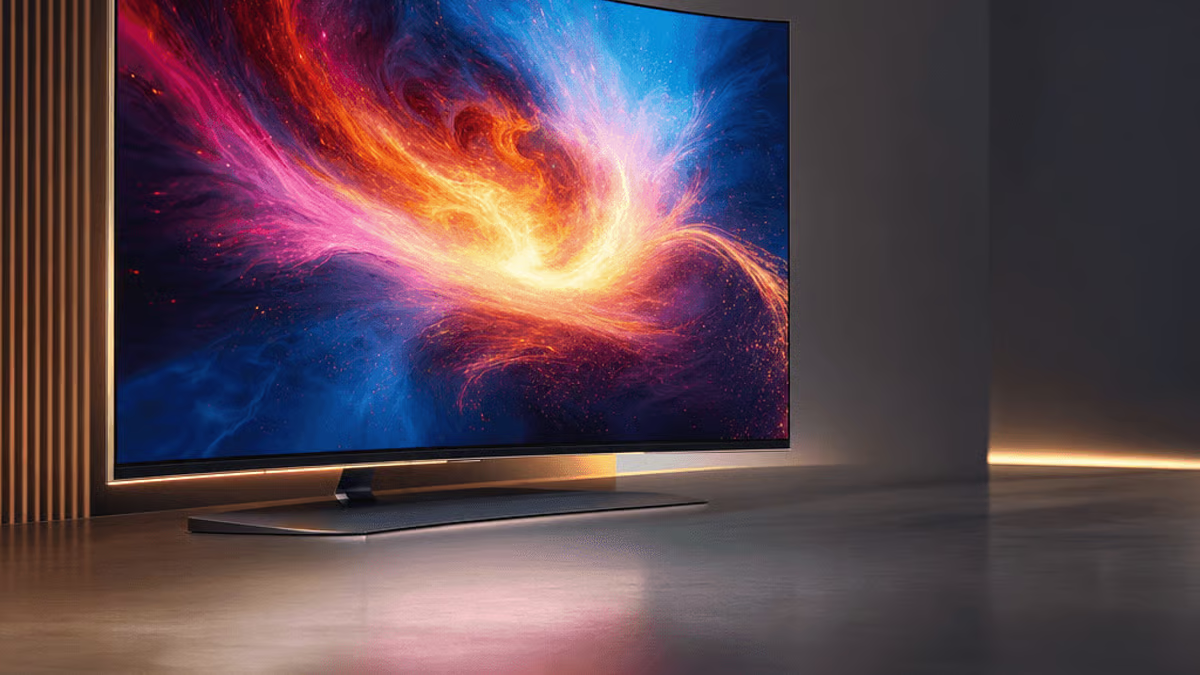
Samsung just gave the industry a preview of its 2026 display strategy, and AI is everywhere. At its Australian Tech Summit in Sydney this week, the Korean tech giant unveiled a complete refresh of its TV and gaming monitor lineup – from 75-inch Micro RGB flagship TVs to glasses-free 3D gaming monitors. The two-day event offered media and industry pros hands-on time with hardware that won’t hit global markets for months, reinforcing Samsung’s 20-year streak as the world’s top TV maker.
Samsung Electronics is making its move in the AI display race, and it’s doing it in Sydney first. The company’s Australian Tech Summit this week pulled back the curtain on a 2026 product lineup that weaves artificial intelligence into everything from premium home TVs to hardcore gaming monitors.
The May 14-15 event wasn’t just another product showcase. It gave media and industry professionals early access to hardware that competitors won’t see on shelves for months, cementing Samsung’s position as the company that’s held the global TV crown for two decades straight. According to Omdia data from February 2026, Samsung just notched its 20th consecutive year as the world’s top TV manufacturer.
But this isn’t about resting on past wins. Samsung’s 2026 strategy puts AI processing at the heart of picture quality, with custom engines that adjust color and contrast on the fly. “Samsung’s 2026 display lineup combines the features consumers value most in TVs and monitors, including stunning picture quality, thoughtful design and AI features that make screens more personal and intuitive,” Hun Lee, Executive Vice President of Visual Display Business at Samsung, said at the summit.
Leading the charge is Samsung’s new Micro RGB TV series, headlined by the flagship 75-inch R95H and R85H models. These aren’t your standard LED TVs – they’re powered by what Samsung calls the Micro RGB AI Engine Pro, which optimizes color and contrast in real time. The company claims the lineup hits 100% of the BT.2020 color space, the broadcast standard that most displays can barely touch.
The tech specs back up the marketing talk. Micro RGB Precision Color 100 delivers what Samsung says is pixel-level color accuracy, while certified Glare Free technology tackles the reflection problem that’s plagued premium TVs for years. Add Vision AI Companion (VAC) into the mix, and you’ve got a TV that doesn’t just display content – it learns viewing habits and adjusts accordingly.
Samsung isn’t stopping at 75 inches, either. The Micro RGB lineup will span from 55 to 115 inches, bringing the same core technology – rich color, sharp contrast, refined local dimming – to living rooms of all sizes. It’s a clear play to dominate the premium TV category across every price tier.
On the OLED front, Samsung’s betting big on the 77-inch S95H. This model combines brighter OLED performance with HDR10+ Advanced technology, which Samsung says delivers more precise brightness control and improved tone mapping compared to standard HDR10+. The S95H also introduces FloatLayer Design, a slimmer aesthetic that makes the TV look more like wall art than consumer electronics when it’s off.
The AI features extend beyond just picture processing. AI Upscaling Pro tackles low-resolution content by enhancing clarity and depth, while AI Soccer Mode Pro optimizes both picture and sound specifically for live sports. There’s even AI Sound Controller Pro, which gives viewers granular control over dialogue, background music, crowd noise, and commentary – useful for anyone who’s ever struggled to hear announcers over stadium roar.
Samsung’s also addressing the living room lighting problem. The S95H pairs HDR10+ Advanced with the same Glare Free tech found in the Micro RGB lineup, maintaining contrast and sharpness even when sunlight hits the screen. Art Mode and integration with Samsung Art Store turn the display into a digital gallery between viewing sessions.
But Samsung isn’t just chasing the home theater crowd. The Odyssey gaming monitor lineup is where things get wild. The 27-inch Odyssey 3D (G90XF) features Eye Tracking and View Mapping technology for glasses-free 3D gaming. It runs at 165Hz with 1ms gray-to-gray response time, delivering depth without the headache-inducing glasses that killed 3D gaming a decade ago.
Then there’s the 32-inch Odyssey G8 (G80HS), which Samsung claims is the industry’s first 6K gaming monitor. Native 165Hz refresh rate, Dual Mode support that cranks up to 330Hz in 3K resolution, and VESA-certified DisplayPort 2.1 connectivity. This is the monitor for people who think 4K isn’t sharp enough.
The OLED gaming side gets the 32-inch Odyssey OLED G8 (G80SH), delivering 4K QD-OLED visuals at 240Hz. Samsung OLED Safeguard+ technology aims to prevent the burn-in issues that have haunted OLED gaming monitors since day one.
Andrew Sohn, Senior Engineer at Samsung Electronics, walked attendees through the Odyssey OLED G8’s display performance during hands-on demos. The message was clear: Samsung’s not just iterating on last year’s models – it’s trying to set new performance benchmarks across refresh rates, resolution, and panel technology.
What ties all these products together is Samsung’s push to make AI features standard across its entire display lineup, not just flagship models. VAC, AI Upscaling Pro, and AI-powered picture optimization are showing up in multiple product lines, suggesting Samsung sees AI processing as the next battleground in consumer electronics.
The Sydney event format itself signals how Samsung views the Australian market – important enough for exclusive early access, but controlled enough to refine messaging before the global rollout. By giving industry professionals hands-on time with 2026 hardware in May, Samsung gets real-world feedback and generates buzz months before competitors can respond.
For the display industry, Samsung’s 2026 lineup sets a high bar. Competitors will need to match not just the hardware specs – 6K resolution, 240Hz OLED, glasses-free 3D – but also the AI processing that’s now baked into every product tier. And with Samsung’s supply chain advantage and 20-year market lead, catching up won’t be easy.
Samsung’s Australian Tech Summit isn’t just about showing off new TVs and monitors – it’s a statement about where the display industry is headed. By embedding AI across every product tier and pushing boundaries with 6K resolution, glasses-free 3D, and advanced OLED tech, Samsung is forcing competitors to either match this level of innovation or cede more ground to a company that’s already dominated TV sales for 20 years. The real test comes when these products hit global markets and consumers decide if AI-powered picture processing and premium features justify the inevitable premium pricing. For now, Samsung’s got the hardware advantage and the market position to make this 2026 lineup the one everyone else has to beat.









Leave a Reply