
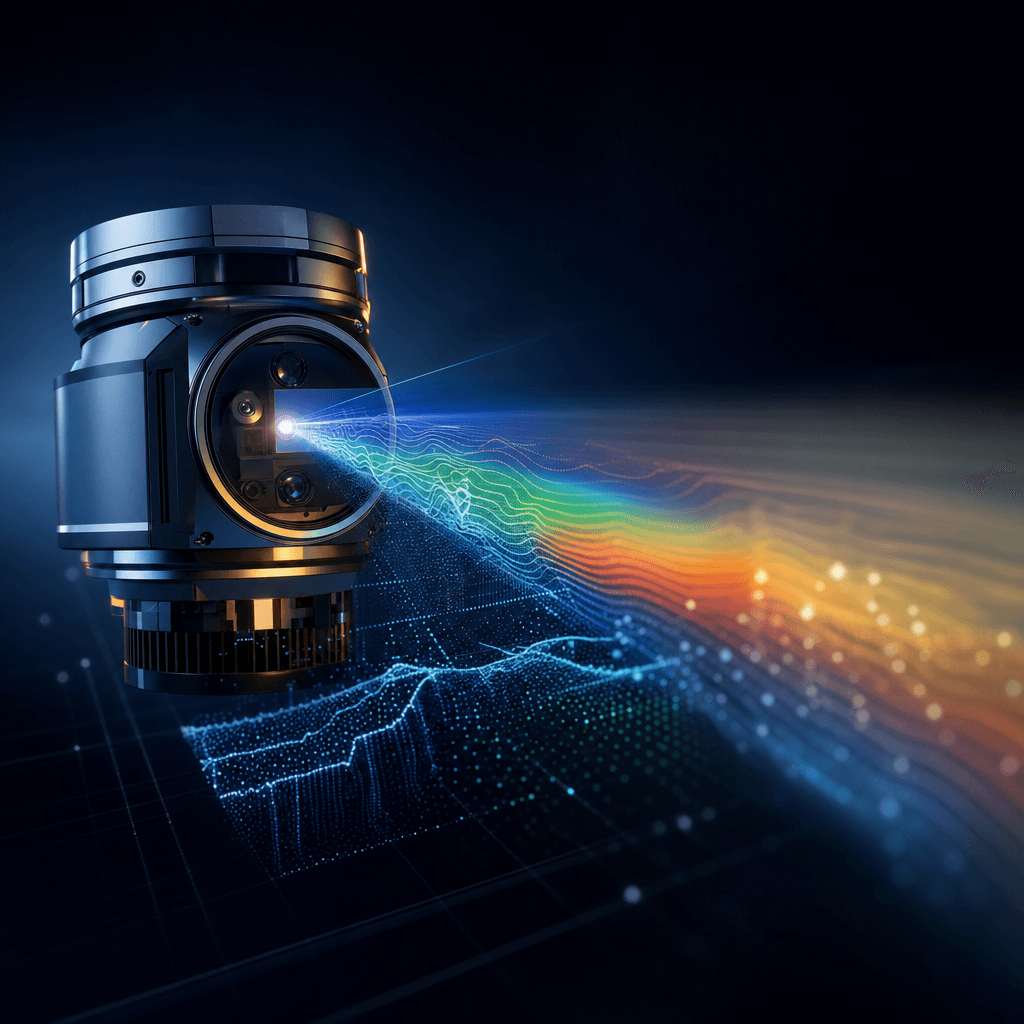
Lidar sensor company Ouster has announced a breakthrough color lidar technology that CEO Angus Pacala describes as a long-sought ‘holy grail’ in the industry, combining depth perception with color image capture in a single sensor designed for autonomous vehicles and robotics applications.
The announcement marks a significant milestone in lidar technology development, as the industry has long pursued sensors capable of capturing both precise depth measurements and color imagery without requiring separate camera systems. This integration could simplify autonomous vehicle sensor suites while reducing costs and complexity. Ouster’s color lidar technology addresses a fundamental challenge in autonomous navigation: the need for comprehensive environmental perception that includes both spatial awareness and visual identification capabilities. Traditional lidar systems excel at measuring distances and creating 3D maps but lack color information, requiring autonomous systems to rely on separate camera arrays for visual recognition tasks. The new sensor promises to streamline this process by delivering both data types from a single unit. For autonomous vehicle manufacturers, this development could represent a meaningful step toward more efficient and cost-effective sensor architectures. The ability to capture depth and color simultaneously may improve object classification accuracy while reducing the computational burden of fusing data from multiple sensor types. The robotics industry also stands to benefit from this technology, particularly in applications requiring precise manipulation and navigation in complex environments.
Ouster’s color lidar technology represents a notable advancement in sensor capabilities for autonomous systems, potentially simplifying sensor architectures while enhancing perception capabilities. As the autonomous vehicle and robotics industries continue to mature, innovations like simultaneous depth and color capture could prove instrumental in achieving the reliability and cost-effectiveness required for widespread commercial deployment.









Leave a Reply