
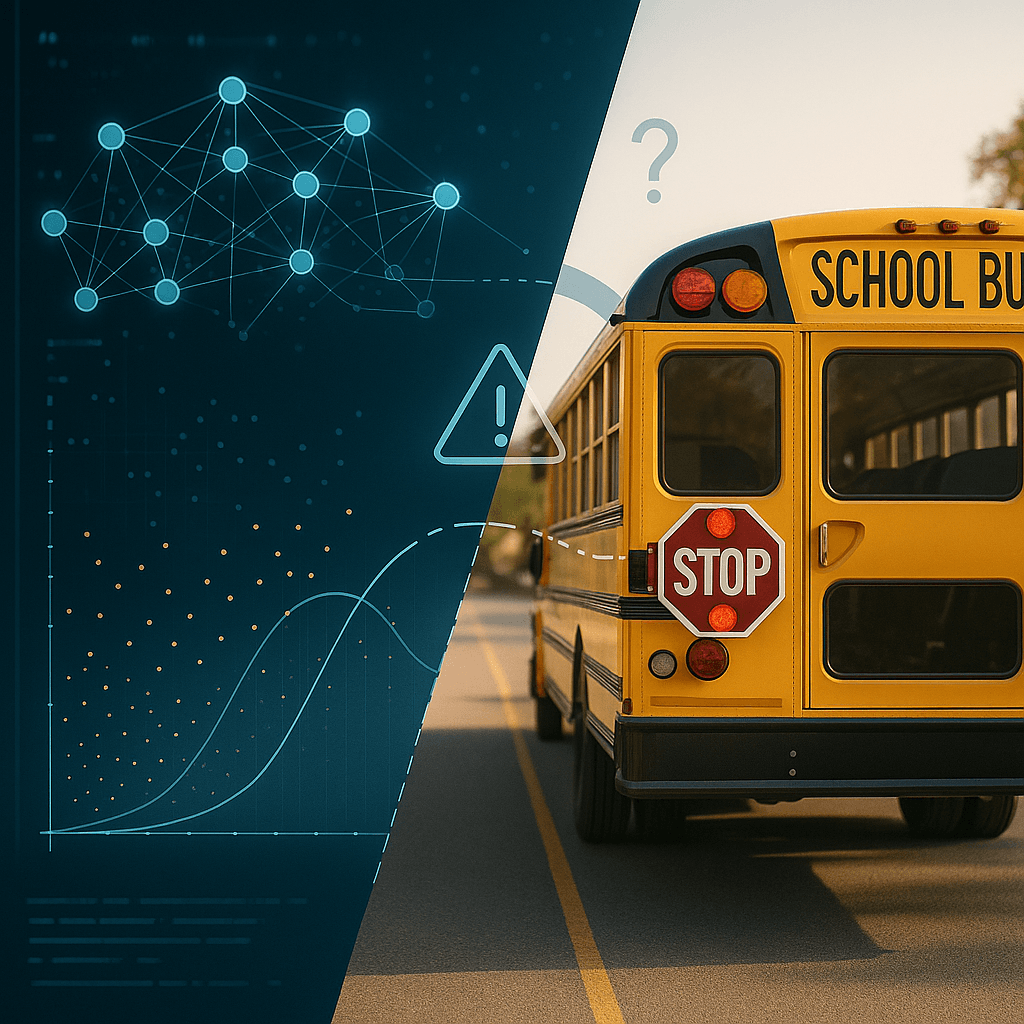
Waymo’s self-driving cars are still blowing past school buses in Austin, even after local officials tried to help the company’s AI learn the rules of the road. The incidents highlight a critical gap in how autonomous vehicles adapt to real-world safety scenarios, raising fresh questions about whether robotaxi operators can reliably handle situations that human drivers master in driver’s ed.
Waymo is facing a troubling pattern in Austin that cuts to the heart of autonomous vehicle safety. Despite a local school district’s efforts to help train the company’s self-driving system, the robotaxis are still failing to stop for school buses with extended stop arms, according to reports from Wired.
The failures are particularly concerning because they involve one of the most basic and critical traffic laws, one designed specifically to protect children. In most states, vehicles must stop when a school bus extends its red stop sign and flashing lights, regardless of which direction they’re traveling. It’s a scenario every human driver learns early on.
But for Waymo’s AI, it’s proving surprisingly difficult. The Austin school district took the unusual step of proactively working with the company to expose its vehicles to school bus scenarios, essentially offering real-world training data on a silver platter. The fact that the system still struggles suggests deeper issues with how machine learning models generalize from training examples to real-world situations.
This isn’t Waymo’s first brush with unusual traffic scenarios. The Alphabet-owned company has logged millions of autonomous miles across San Francisco, Phoenix, Los Angeles, and Austin. But edge cases, those rare situations that don’t fit neatly into training datasets, continue to trip up even the most sophisticated self-driving systems.
The incidents raise uncomfortable questions for the autonomous vehicle industry as it pushes for wider deployment. If a robotaxi company can’t reliably handle school buses even with targeted training, what other scenarios might slip through the cracks? Construction zones? Emergency vehicles? Crossing guards?
Waymo has built its reputation on a cautious, data-driven approach to autonomy. The company’s vehicles use a combination of lidar, radar, and cameras to build a 360-degree view of their surroundings, with machine learning models trained on billions of miles of simulated and real-world driving. But the Austin school bus problem exposes a fundamental tension in AI development. Machine learning systems excel at pattern recognition when they’ve seen enough examples, but they can struggle with scenarios that differ even slightly from their training data.










Leave a Reply