
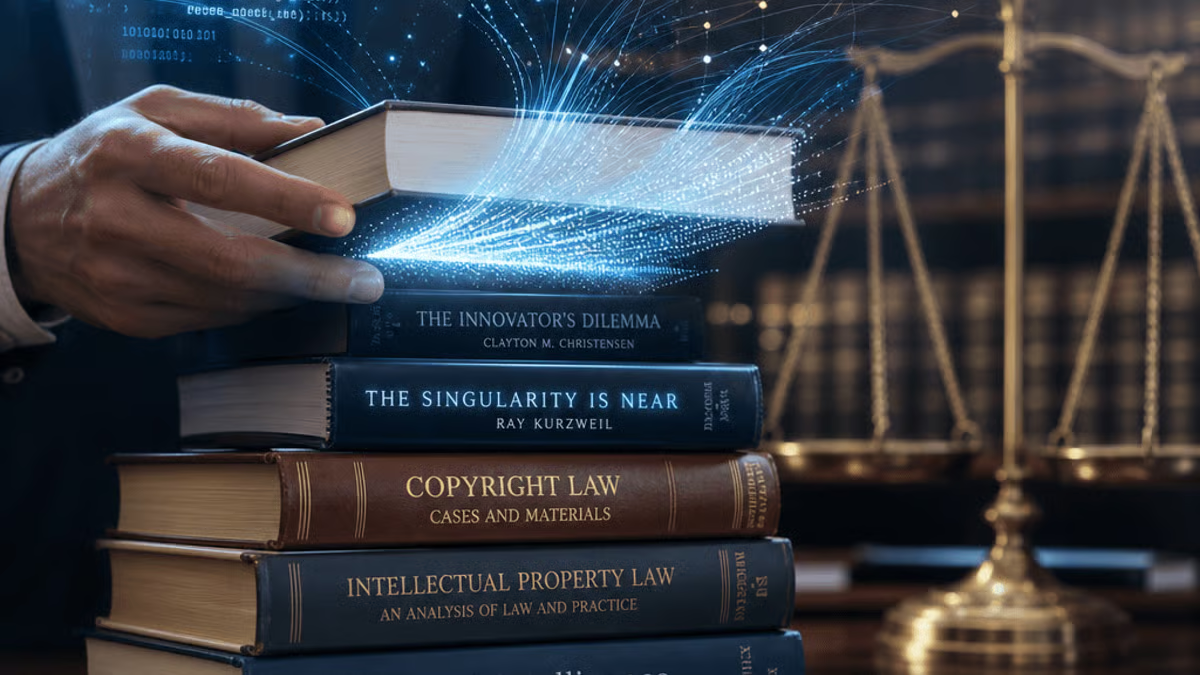
Thousands of published authors just discovered their life’s work is powering the very AI systems threatening to make them obsolete. OpenAI, Meta, Google, and other tech giants have been scraping copyrighted books to train large language models without permission or compensation. The question keeping writers and lawyers up at night: is any of this actually legal? The answer is frustratingly murky, hinging on an untested interpretation of fair use doctrine that’s now playing out in courtrooms across the country.
The revelation hit the literary world like a plot twist nobody saw coming. Books by thousands of authors—from bestselling novelists to academic researchers—have been feeding AI models for years. OpenAI didn’t ask permission before ingesting entire libraries to train GPT-3 and GPT-4. Neither did Meta for its LLaMA models, or Google for its various AI projects.
The Authors Guild fired the opening salvo in 2023, filing a class-action lawsuit against OpenAI on behalf of prominent writers including John Grisham and George R.R. Martin. The complaint alleges systematic copyright infringement on a scale that would’ve been impossible before AI. According to court documents, the models were trained on datasets like Books3, which contains roughly 200,000 pirated books scraped from the internet without any licensing agreements.
“We’re not talking about someone photocopying a chapter for a book club,” one literary agent told the court in a filing. “This is industrial-scale copying of entire works to create commercial products that directly compete with the original authors.”
But OpenAI and its peers aren’t backing down. Their defense rests on fair use, the same legal doctrine that protects parody, criticism, and transformative works. In motions to dismiss, OpenAI argued that training AI models constitutes transformative use because the output doesn’t reproduce the original books—it creates entirely new text based on statistical patterns learned from millions of sources.
“The model learns language, not content,” OpenAI stated in court filings. “It’s no different than a human reading widely to understand how to write.”
That comparison makes copyright scholars wince. The Copyright Act of 1976 established four factors for determining fair use: the purpose of use, the nature of the copyrighted work, the amount used, and the effect on the market. AI training potentially fails on multiple counts.
First, these are for-profit companies building commercial products. OpenAI charges $20 monthly for ChatGPT Plus and licenses its technology to Microsoft in a deal reportedly worth $10 billion. That undercuts the “nonprofit educational use” argument that typically strengthens fair use claims.
Second, the companies copied entire books, not excerpts. Traditional fair use cases involve using small portions—a quote, a chapter, perhaps. Meta and OpenAI ingested complete works from beginning to end.
Most damaging is the market harm question. Authors and publishers argue AI writing tools directly threaten their livelihoods. Why would publishers commission human writers for certain content when AI can generate similar material instantly at near-zero cost? Early data suggests they won’t—several publishing houses have already experimented with AI-generated content for everything from stock photo descriptions to genre fiction.
The tech companies counter that AI tools expand the market by making writing assistance accessible to everyone, potentially increasing overall demand for human creativity. They point out that ChatGPT can’t write the next great novel, just competent prose.
Legal experts remain divided on how courts will rule. “We’re applying 18th-century copyright concepts to 21st-century technology,” one Stanford law professor noted. “Fair use was designed for human-scale creative reuse, not machines processing millions of works to extract statistical patterns.”
The uncertainty stems from genuine novelty. No court has definitively ruled on whether training AI models on copyrighted material constitutes infringement. Lower courts have issued conflicting preliminary rulings, and the Supreme Court hasn’t weighed in.
Meanwhile, the AI companies are hedging their bets. OpenAI recently launched a program allowing publishers to opt out of future training, though it doesn’t address past use. Google and others are quietly negotiating licensing deals with major publishers, essentially admitting they might need permission after all.
The financial stakes are staggering. If courts rule against fair use, AI companies could face statutory damages of up to $150,000 per willfully infringed work. With potentially hundreds of thousands of books involved, that’s billions in exposure. More importantly, it could force a complete restructuring of how AI models are trained.
Some technologists warn that strict copyright enforcement could kneecap American AI development, pushing innovation to countries with looser intellectual property protections. Others argue that’s fearmongering—plenty of licensed content exists, and companies could negotiate reasonable rates or focus on public domain works and authorized datasets.
The reality is that copyright law is struggling to keep pace with technology, again. The same debates played out with photocopiers, VCRs, Napster, and YouTube. Each time, courts eventually drew new boundaries, often with legislative help.
What makes this case different is the speed and scale. AI companies trained their models first and are asking legal questions later. They’ve built trillion-dollar valuations on foundations that might be legally unsound. Authors, meanwhile, are watching AI systems learn to mimic their narrative voices, their technical expertise, their creative choices—all without compensation or credit.
The legal battle over AI training data is really a fight about who controls knowledge in the algorithmic age. If courts side with tech companies, we’re accepting a world where human creative output becomes raw material for machines, with creators having little say in how their work is used. If they side with authors, AI development might slow, but it’ll be forced onto more ethical foundations built on consent and compensation. Either way, the current free-for-all is ending. The question isn’t whether AI companies will eventually need to license training data—it’s whether they’ll have to pay retroactively for what they’ve already taken.







Leave a Reply