
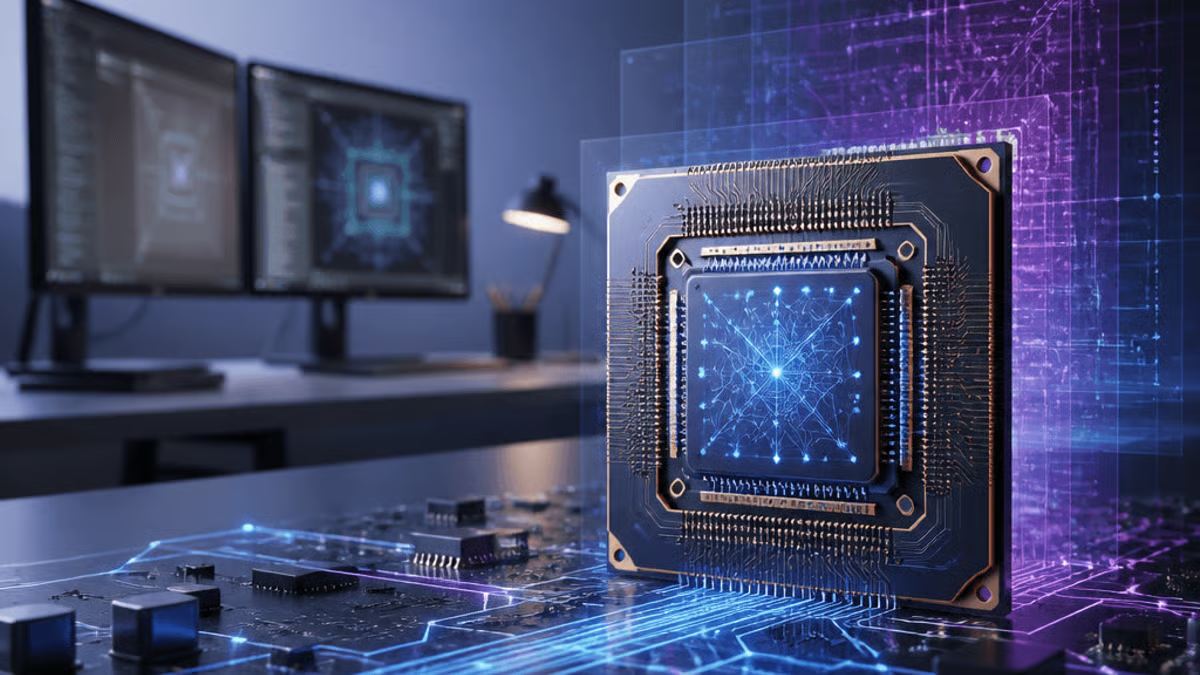
Anthropic is making a bold play for control of its AI destiny. The Claude-maker just started hiring for a dedicated chip design team, signaling it’s joining rivals OpenAI and Google in the race to build custom silicon. According to a TechCrunch report, the company plans to co-design hardware specifically optimized for its large language models – a move that could slash costs and boost performance while reducing its dependence on Nvidia‘s increasingly scarce GPUs.
Anthropic just dropped a hiring bombshell that puts it squarely in the custom chip wars. The AI startup behind Claude is assembling a team to design its own silicon, joining an exclusive club of tech giants betting their futures on proprietary hardware.
The company says it plans to “co-design hardware and models” to make its technology run faster and more efficiently, according to the TechCrunch report. That’s startup-speak for “we’re tired of paying Nvidia’s prices and waiting in line for H100s.”
And who can blame them? The entire AI industry is bottlenecked by Nvidia‘s GPU supply chain. Training runs cost millions, inference at scale burns cash, and every AI company is essentially renting compute from the same landlord. Google figured this out years ago with its TPU chips. OpenAI reportedly started designing custom silicon last year. Now Anthropic is making the same calculation.
The timing makes sense. Anthropic raised over $7 billion across multiple funding rounds from backers including Google, Salesforce, and various venture firms. That’s enough runway to take on the multi-year, capital-intensive challenge of chip development. But it’s not just about having deep pockets – it’s about survival.
Custom chips offer three killer advantages. First, you optimize the entire stack from silicon to software, squeezing out performance gains that off-the-shelf GPUs can’t match. Second, you slash long-term costs once you’ve absorbed the upfront R&D hit. Third, you control your own destiny instead of competing for allocation when Nvidia’s newest chips launch.
Meta learned this lesson building its custom training and inference accelerators. Amazon developed its Trainium and Inferentia chips for AWS. Microsoft quietly built its own AI accelerators too. The pattern is clear – if you’re serious about AI at scale, you need your own silicon strategy.
For Anthropic, the stakes are especially high. Claude competes directly with OpenAI‘s GPT-4 and Google‘s Gemini. Performance and cost efficiency aren’t nice-to-haves, they’re existential. Every millisecond of latency matters. Every dollar of inference cost affects pricing competitiveness.
The challenge? Chip design is brutally hard. It takes years to go from concept to production. You need world-class engineers – the kind Apple and Nvidia fight over. Then there’s manufacturing, which means navigating relationships with TSMC or Samsung foundries. And if your first chip doesn’t deliver, you’ve burned millions with nothing to show.
But the upside is massive. Imagine Claude running 2x faster at half the cost. That’s not incremental – that’s game-changing for enterprise adoption and consumer pricing. It’s the difference between breaking even and printing money on every API call.
The broader trend is undeniable. AI is eating the chip industry from the inside out. Traditional CPU architectures weren’t built for transformer models and massive matrix multiplication. GPUs bridged the gap, but they’re general-purpose tools being forced into specialized roles. The next generation of AI infrastructure will run on silicon designed specifically for neural networks.
Anthropichasn’t disclosed specifics about its chip roadmap, team size, or timeline. That’s typical for early-stage hardware efforts – you don’t tip your hand until you’ve got something to ship. But the mere fact they’re hiring sends a signal to the market: we’re playing the long game.
This also puts pressure on Nvidia. Every AI company building custom chips is a potential customer lost. Yes, Nvidia still dominates training workloads and will for years. But inference – where the real volume lives – is up for grabs. If Anthropic, OpenAI, Google, and others succeed with custom silicon, Nvidia’s moat gets narrower.
The wildcard is whether Anthropic goes for training chips, inference chips, or both. Training requires different architectures than inference. Google‘s TPUs handle both, but at massive scale and cost. Smaller players often start with inference optimization since that’s where immediate cost savings live. We’ll have to wait for job postings and engineer backgrounds to read the tea leaves.
Anthropic’s chip play is about more than just cutting costs or boosting performance – it’s about control in an industry where infrastructure is destiny. As AI models grow exponentially and compute becomes the ultimate competitive advantage, owning your silicon stack transitions from luxury to necessity. Whether Anthropic can execute remains to be seen, but the fact they’re trying tells you everything about where this industry is headed. The companies that win the 2030s won’t just build better models – they’ll build the chips those models run on.









Leave a Reply