
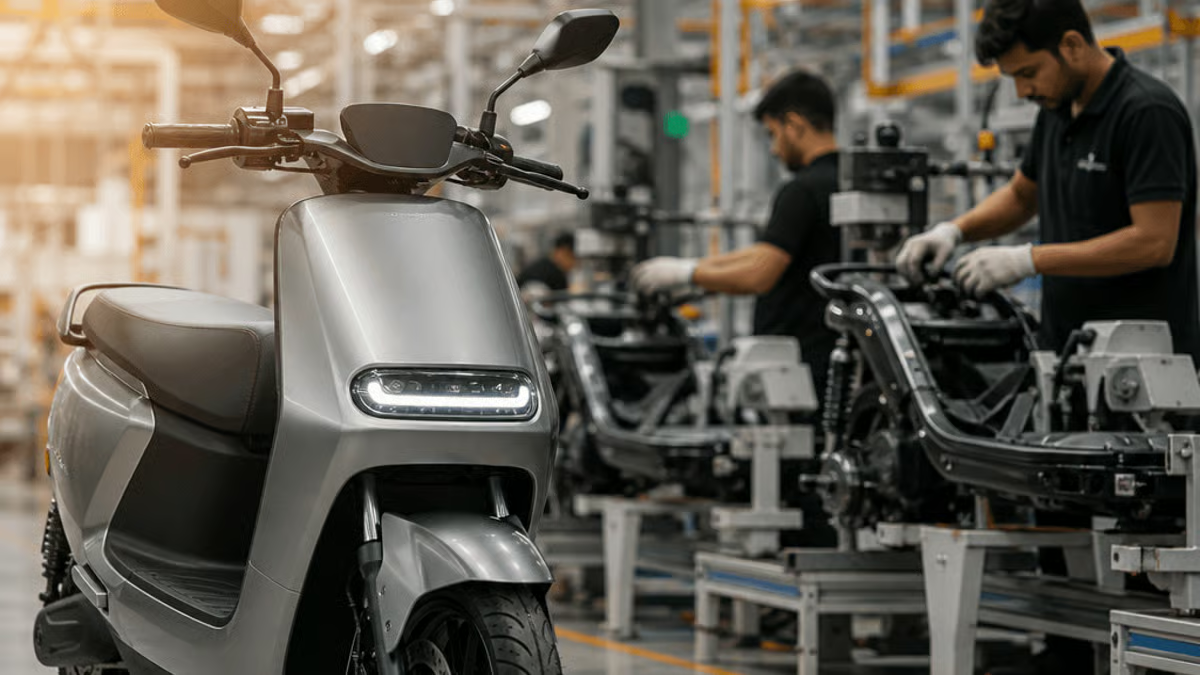
India’s electric two-wheeler market just got a major vote of confidence. River, the Bengaluru-based EV startup that’s been quietly scaling with a single scooter model, closed a $120 million Series C round to fund factory expansion and a multi-model product roadmap starting in 2027. The raise signals growing investor appetite for India’s electrification push, where two-wheelers dominate urban transport and government subsidies are making EVs increasingly viable.
River just proved you don’t need a massive product portfolio to attract serious capital. The Indian electric scooter maker closed $120 million in Series C funding, betting that disciplined execution with a single model can win over investors more effectively than the spray-and-pray approach many EV startups have taken.
The Bengaluru-based company plans to funnel the fresh capital into a new manufacturing facility and an expanded product lineup launching in 2027, according to TechCrunch. It’s a significant escalation for a startup that’s spent the past few years refining production processes and unit economics around a single scooter design.
The timing couldn’t be better. India’s electric two-wheeler segment is exploding, driven by government subsidies under the FAME II scheme and persistently high petrol prices that make the economics of electric increasingly compelling for middle-class buyers. Two-wheelers account for roughly 70% of India’s vehicle market, making electrification here potentially more impactful than passenger cars.
River’s approach stands in sharp contrast to competitors who’ve rushed to market with multiple models before nailing down manufacturing efficiency. By focusing on a single product, the company appears to have ironed out supply chain kinks and production costs that typically plague early-stage hardware startups. That discipline likely made the pitch to Series C investors considerably easier.
The new factory will give River the capacity it needs to scale beyond its current production constraints. While the company hasn’t disclosed specific production targets, the $120 million raise suggests ambitions well beyond the boutique volumes that characterize most Indian EV startups today. Capital efficiency will be critical as the company pushes toward profitability, a goal it’s now explicitly targeting.
What makes River’s raise particularly notable is the broader context of EV funding in India. While early-stage capital has flowed freely to mobility startups over the past three years, Series C rounds of this size remain relatively rare. Investors are getting pickier, demanding proof of operational excellence and a credible path to positive unit economics before writing larger checks.
The 2027 product roadmap expansion will test whether River can replicate its success across multiple models. New launches mean new supply chains, new manufacturing processes, and new go-to-market strategies. The company will need to avoid the trap of overextension that’s claimed other hardware startups who scaled their SKU count faster than their operational capabilities.
Competition is intensifying across the board. Legacy players like Bajaj and TVS have launched electric models with established dealer networks and brand recognition. Well-funded startups like Ather and Ola Electric are pouring resources into charging infrastructure and technology differentiation. River will need to carve out a distinct positioning as the market fragments.
The profitability target is the real headline here. Too many EV startups have prioritized growth at all costs, burning through capital to subsidize sales and grab market share. River’s stated focus on reaching breakeven suggests a more measured approach, one that could prove more sustainable if the funding environment tightens or subsidy regimes change.
India’s EV infrastructure remains a work in progress, with charging networks still sparse outside major metros and battery costs still accounting for a significant portion of vehicle pricing. River will need to navigate these structural challenges while executing on factory construction, new product development, and scaling sales simultaneously.
The Series C also positions River for potential later-stage rounds or strategic partnerships as the market matures. With manufacturing capacity in place and multiple models in market by 2028, the company could become an attractive acquisition target for global OEMs looking to enter India or a candidate for public markets if it hits profitability milestones.
River’s $120 million Series C represents a bet on operational discipline over flashy product launches. By proving it could scale profitably with one model before expanding, the startup has potentially cracked the code that’s eluded many hardware companies. The real test comes in 2027 when new models hit the market and the company needs to replicate that success across multiple product lines while navigating India’s evolving EV landscape. If River can execute on its factory buildout and reach profitability while expanding its lineup, it’ll validate a playbook other EV startups might want to copy. The alternative is joining the long list of well-funded hardware companies that scaled too fast and collapsed under operational complexity.







Leave a Reply