
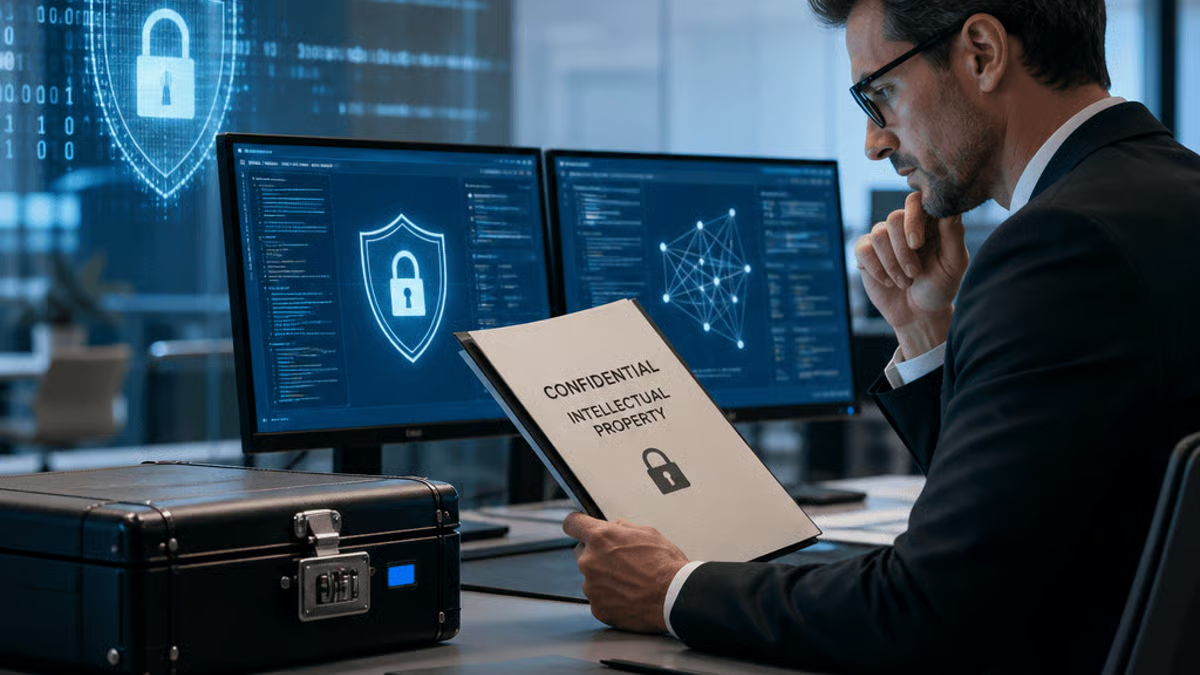
The legal battle between Apple and OpenAI just escalated. In a fresh court filing, Apple claims its trade secrets investigation has widened to include more former employees who may have retained or accessed confidential information before jumping ship to the AI startup. The development marks a significant expansion of what’s already become one of tech’s most closely watched IP disputes, raising fresh questions about how companies protect proprietary AI research when talent moves between rivals.
Apple just turned up the heat on OpenAI. The iPhone maker’s trade secrets investigation has expanded beyond its initial targets, with new court filings suggesting a broader pattern of alleged data misappropriation by former employees who landed at the ChatGPT creator.
The filing, submitted to a California court, claims Apple has uncovered evidence that additional ex-staff members may have retained or accessed confidential information during their transitions to OpenAI. While Apple hasn’t disclosed the exact number of new individuals under scrutiny or the specific nature of the allegedly compromised data, the widening scope signals the company is treating this as more than an isolated incident.
This isn’t Apple’s first rodeo with employee defections to AI competitors. The Cupertino giant has long guarded its machine learning and AI research with notorious secrecy, requiring employees to sign strict non-disclosure agreements. But OpenAI has been a particularly magnetic force in the AI talent wars, offering researchers the chance to work on cutting-edge large language models and publicly visible projects – a stark contrast to Apple’s traditionally tight-lipped approach.
The original lawsuit centered on allegations that former Apple engineers took proprietary information about AI training methods, model architectures, and potentially even code when they moved to OpenAI. Now, with the investigation expanding, legal experts suggest Apple may have discovered communications or data transfers it believes constitute a systematic pattern rather than individual lapses in judgment.
“When you see an investigation widen like this, it usually means the plaintiff found something during discovery that raised red flags,” says Sarah Chen, an intellectual property attorney who specializes in tech trade secrets cases. “Apple wouldn’t expand the scope unless they had evidence suggesting a broader issue.”
The timing couldn’t be more sensitive. Both companies are racing to dominate the AI landscape – Apple with its on-device AI features and privacy-focused approach, OpenAI with its cloud-based models and partnerships with Microsoft. Every piece of proprietary research represents millions in R&D investment and potential competitive advantage.
For OpenAI, the expanding probe creates an uncomfortable narrative. The company has positioned itself as the premier destination for AI talent, actively recruiting from competitors including Google, Meta, and Apple. But if courts find merit in Apple’s claims, it could complicate future hiring efforts and expose OpenAI to substantial damages.
The legal battle also reflects a broader industry tension. As AI becomes the defining technology race of the decade, companies are simultaneously trying to attract top talent while preventing their own researchers from taking institutional knowledge elsewhere. It’s a delicate balance that’s proving harder to maintain as AI labs compete for a limited pool of experts.
Apple’s aggressive legal stance sends a clear message to the industry: it won’t tolerate what it views as IP theft, even as it competes for the same talent pool. The company has historically been less litigious than peers like Oracle or even Google, making this expanded investigation all the more notable.
Neither Apple nor OpenAI responded to requests for comment on the new filing. OpenAI has previously denied any wrongdoing and stated it has policies in place to ensure new hires don’t bring confidential information from previous employers.
The case is still in early stages, but discovery could reveal fascinating details about what Apple considers its crown jewels in AI research and how OpenAI onboards employees from competitors. If the investigation continues expanding, we might see more names surface – and potentially more tech giants watching nervously from the sidelines.
What happens next will likely depend on what Apple’s forensic investigation uncovers. If the company can demonstrate that multiple employees coordinated to take confidential data, it could pursue criminal charges beyond civil litigation. At minimum, expect aggressive discovery requests and potentially emergency injunctions to prevent further alleged misuse of trade secrets.
This widening investigation represents more than just another corporate lawsuit – it’s a flashpoint in the AI talent wars that could reshape how tech companies handle employee transitions. As Apple digs deeper and potentially uncovers more alleged data breaches, the case will test the boundaries of trade secret protection in an era when AI expertise is the most valuable currency in tech. For OpenAI, the stakes are reputational as much as financial. For Apple, it’s about drawing a line in the sand. And for the dozens of AI researchers who move between companies each year, the outcome could determine just how freely they can apply their knowledge at new employers. Watch this space – the next filing could name names.




Leave a Reply