
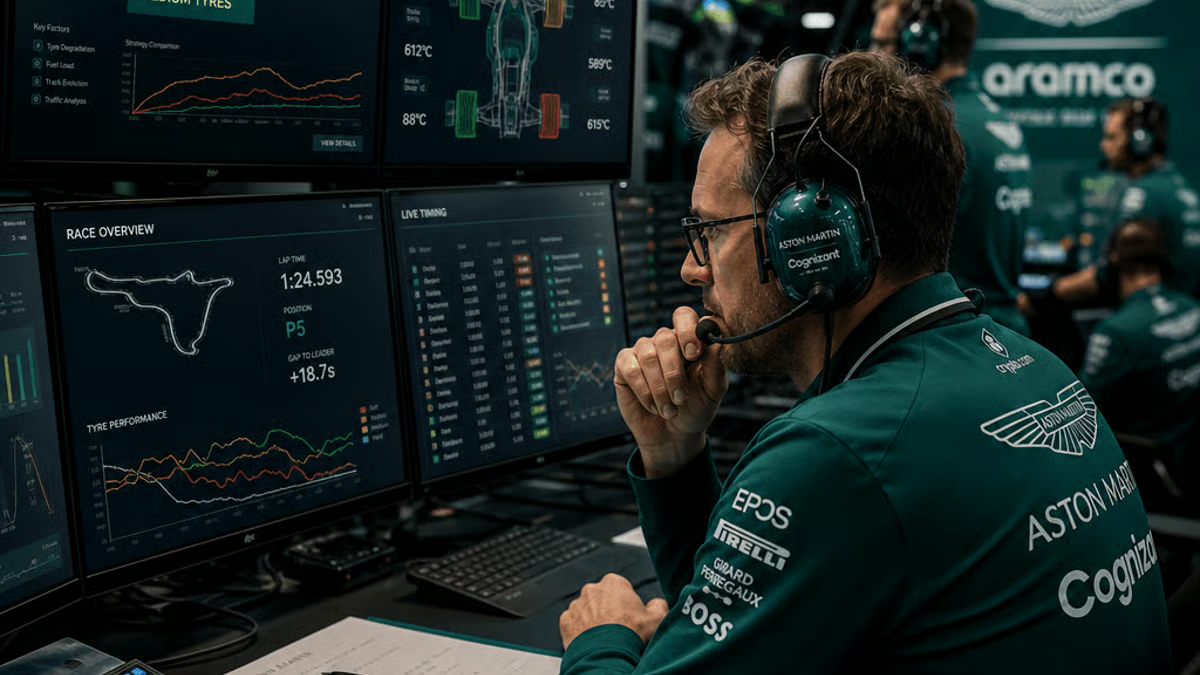
The most data-intensive sport on Earth just delivered a counterintuitive verdict on artificial intelligence. Aston Martin Aramco F1 executives say their competitive advantage doesn’t come from AI automation, but from expert humans wielding AI tools. In a sport where milliseconds separate podium finishes from midfield obscurity, the team’s approach challenges the automation-first narrative dominating enterprise tech and offers a glimpse into how high-stakes industries are really deploying AI in 2026.
Formula One teams process more data per race weekend than most enterprises handle in a month. Every car generates roughly 1.5 million data points per second, streaming telemetry on tire temperatures, aerodynamic efficiency, fuel consumption, and dozens of other variables that determine whether a driver crosses the finish line first or fifteenth.
Aston Martin Aramco F1 operates in this data deluge, but the team’s executives and technology partners are pushing back against the notion that AI should automate its way to victory. According to insights shared by the team, competitive advantage comes from what they call ‘professional handcraft’ – the irreplaceable expertise of engineers and strategists using AI to enhance, not replace, their judgment.
This isn’t just a philosophical stance. In F1, regulations tightly control what teams can automate during races. Driver aids like traction control have been banned since 2008, and even pit-to-car communications face restrictions. But beyond the rulebook, Aston Martin’s approach reflects a broader realization rippling through enterprise AI deployments: the algorithms are only as good as the humans directing them.
The team reportedly uses AI and machine learning models to process real-time race data, simulate strategy scenarios, and optimize car setup for different track conditions. But the critical calls – when to pit, which tire compound to choose, how aggressively to push the engine – still flow through experienced human decision-makers who understand context that no model can fully capture.
Consider a scenario that played out across multiple races this season. AI models can predict optimal pit stop windows based on tire degradation curves and fuel loads. But they can’t always account for a rival team’s unexpected strategy shift, a sudden weather change that defies forecasting models, or the psychological state of a driver battling for championship points. That’s where the ‘human in the loop’ becomes indispensable.
This philosophy mirrors emerging best practices in enterprise AI adoption. Companies deploying AI systems are discovering that the highest ROI comes not from replacing expert workers but from amplifying their capabilities. Medical diagnostics, financial trading, supply chain optimization – all show better outcomes when AI handles pattern recognition and humans handle judgment calls.
Aston Martin’s technology partners have built systems that can ingest vast datasets and surface insights in seconds. During a race, engineers receive AI-generated recommendations on everything from brake cooling to energy recovery strategies. But the final decision authority remains with specialists who’ve spent decades understanding the nuances of high-performance racing.
The approach also addresses a critical challenge facing AI deployment across industries: trust. In F1, a wrong call can cost millions in prize money and irreparably damage a season’s championship hopes. Teams can’t afford to blindly follow algorithmic recommendations. By keeping humans in the decision loop, Aston Martin maintains accountability and builds confidence in AI as a tool rather than a replacement.
This ‘handcraft’ methodology extends to car development, where AI models simulate aerodynamic performance and structural integrity. Computational fluid dynamics models can test thousands of wing configurations virtually, but experienced aerodynamicists interpret the results, understanding which simulated gains will translate to real-world track performance and which represent modeling artifacts.
The team’s stance arrives as the broader tech industry grapples with AI implementation challenges. Early automation promises often collide with messy reality, where edge cases, regulatory requirements, and stakeholder trust demand human oversight. F1’s data-intensive, high-stakes environment serves as a proving ground for enterprise AI strategies.
What makes this approach particularly relevant beyond motorsport is the competitive pressure. F1 teams face zero tolerance for underperformance. If full AI automation delivered better results, teams would pursue it within regulatory limits. That they’re instead doubling down on human expertise augmented by AI suggests this model works under the most demanding conditions.
The implications extend to industries from healthcare to finance, where decision quality matters more than decision speed alone. AI can process information faster than any human, but it can’t replicate the accumulated wisdom, contextual understanding, and ethical reasoning that expert practitioners bring to complex problems.
Aston Martin F1’s human-centric AI strategy offers a roadmap for enterprises navigating their own AI deployments. In an era of automation hype, the team’s success with augmentation over replacement demonstrates that competitive advantage often comes from empowering experts rather than eliminating them. As AI capabilities expand, the question isn’t whether machines can make decisions, but whether they should – and in high-stakes environments from racetracks to boardrooms, the answer increasingly points toward keeping skilled humans in the driver’s seat with AI riding shotgun.










Leave a Reply