
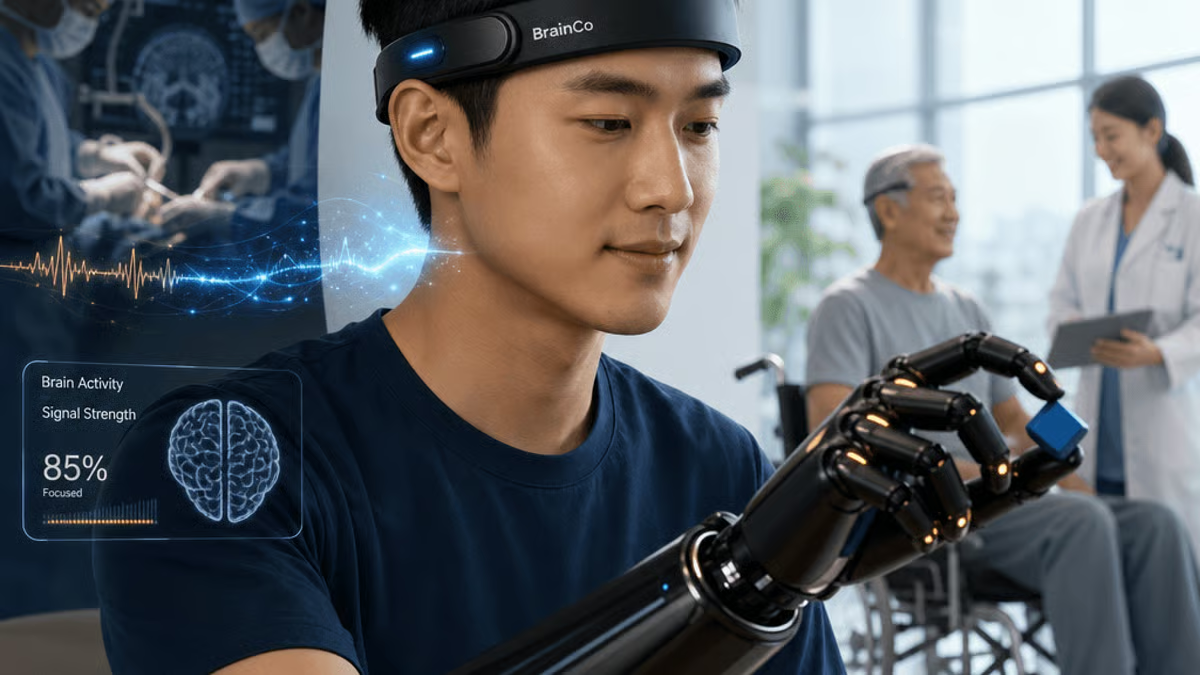
While Elon Musk’s Neuralink grabs headlines drilling into skulls, a Harvard-incubated Chinese startup is making a quieter bet: the future of brain-computer interfaces doesn’t require surgery at all. BrainCo’s wearable neural devices are gaining traction in rehabilitation and accessibility markets, challenging the narrative that invasive implants are the only path forward for brain tech. The split reveals a fundamental divide in how the industry thinks about connecting minds to machines.
BrainCo, a brain-computer interface startup born from Harvard’s Innovation Lab, is doubling down on a contrarian vision for neural technology. While Neuralink – Elon Musk’s high-profile implant company – recently completed its first human trials with surgically embedded electrodes, BrainCo argues the real breakthrough won’t happen in operating rooms.
The company’s wearable headbands and prosthetic limbs use external sensors to detect brain activity, translating neural signals into commands without penetrating the skull. It’s a fundamentally different approach to the same problem: helping people with paralysis, amputations, or neural disorders regain control.
“We’re seeing genuine demand from rehabilitation centers and individuals who need solutions today, not five years from now,” a BrainCo representative told industry analysts during a recent demonstration. The startup’s prosthetic hand, controlled entirely by muscle and neural signals detected through the skin, has already reached hundreds of users across Asia.
The timing puts BrainCo in direct philosophical opposition to Neuralink’s invasive methodology. Musk’s company argues precision requires proximity – electrodes placed directly on brain tissue can capture signals with far greater fidelity than external sensors. But that precision comes with surgical risks, regulatory hurdles, and a price tag that puts the technology out of reach for most potential users.
BrainCo’s bet is that 80% accuracy at 10% of the cost beats 99% accuracy that requires neurosurgery. The company’s devices reportedly cost thousands rather than hundreds of thousands of dollars, opening markets in developing economies where invasive brain surgery simply isn’t practical.
The brain-computer interface market is heating up fast. Beyond Neuralink and BrainCo, companies like Synchron are developing minimally invasive alternatives using catheter-based implants, while Emotiv and Kernel pursue different flavors of non-invasive sensing. Analysts project the BCI market could exceed $5 billion by 2030 as applications expand from medical rehabilitation into gaming, productivity, and communication.
What separates BrainCo is its focus on immediate clinical utility. The company’s prosthetic devices don’t just read neural intent – they provide haptic feedback, creating a closed loop that helps users regain a sense of touch. Users report being able to feel pressure and texture through the prosthetic hand, a capability that dramatically improves usability.
China’s aggressive investment in neurotechnology gives BrainCo advantages Neuralink doesn’t enjoy. The country has prioritized brain science in its national strategic plans, and regulatory pathways for medical devices can move faster than in the US. BrainCo has already secured medical device certifications in China and is expanding into Southeast Asian markets where demand for affordable assistive technology is exploding.
But non-invasive approaches have hard limits. External sensors can’t yet match the signal clarity of implanted electrodes, which means fine motor control remains challenging. Neuralink’s recent demonstrations showed paralyzed patients controlling computer cursors with remarkable precision – something current wearable BCIs struggle to replicate.
The real question isn’t whether invasive or non-invasive wins, but where each approach finds its niche. Invasive BCIs might dominate applications requiring high precision – think restoring complex hand movements or treating severe neurological conditions. Wearable devices could own the broader market: basic prosthetic control, cognitive monitoring, rehabilitation therapy, even consumer applications like focus training.
BrainCo seems to be making that exact calculation. Rather than compete head-to-head with Neuralink for the most impressive technical demos, it’s building distribution in markets where good-enough technology deployed today beats perfect technology arriving in 2030.
The startup’s Harvard pedigree and Chinese manufacturing scale give it unique positioning. Founded by researchers who studied neuroscience and AI at Harvard, then moved production to China to access advanced manufacturing and lower costs, BrainCo straddles both ecosystems.
Industry observers note the approach mirrors how Chinese companies have disrupted other hardware markets – not by beating Western competitors on cutting-edge specs, but by delivering accessible versions of advanced technology at scale. It’s the playbook that worked for smartphones, drones, and electric vehicles.
For people living with paralysis or limb loss today, the debate over invasive versus non-invasive is almost beside the point. What matters is access to technology that works well enough to restore independence. If BrainCo can deliver that at a price point healthcare systems and individuals can actually afford, the company might capture the market while competitors are still perfecting their surgical techniques.
The brain-computer interface war isn’t just about technology – it’s about philosophy. Neuralink bets on surgical precision unlocking the brain’s full potential. BrainCo wagers that wearable accessibility will reach more people faster, turning a futuristic concept into practical rehabilitation tools today. Both approaches will likely coexist, serving different needs at different price points. But for millions living with neural disabilities right now, BrainCo’s message resonates: the best brain-computer interface is the one you can actually get. As the market matures, watch whether precision or accessibility captures the bigger piece of what could become a transformative industry.











Leave a Reply