
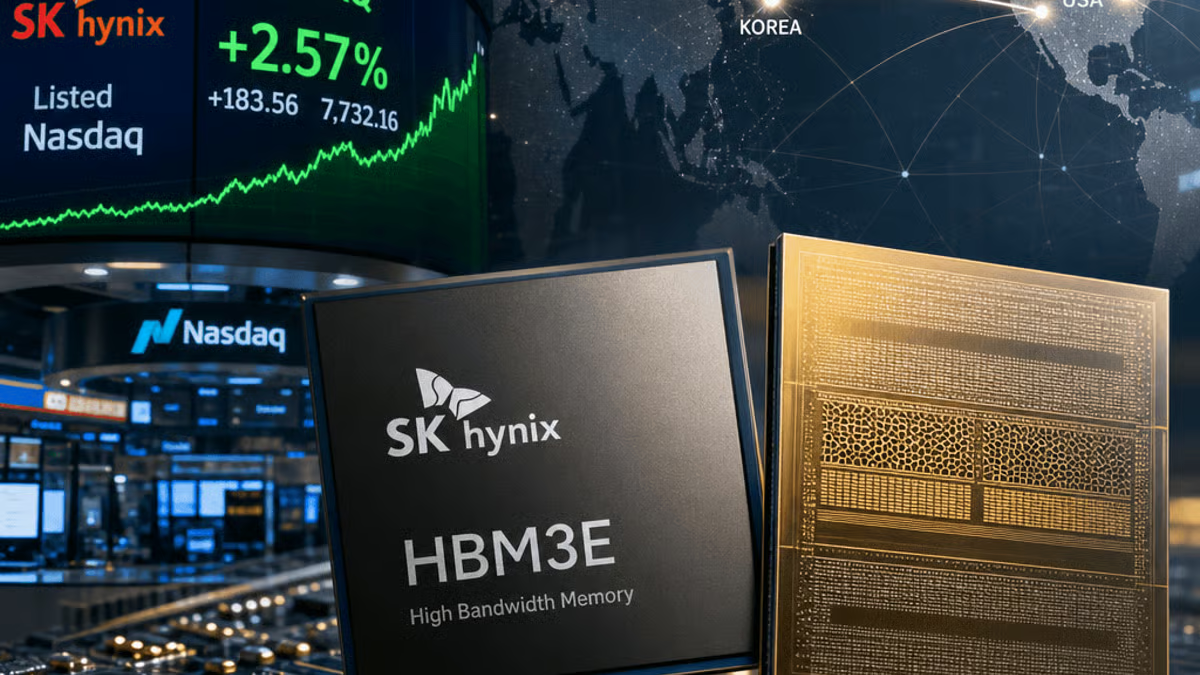
SK Hynix just rang the opening bell at Nasdaq, marking a watershed moment for Korean tech companies fighting a decades-old valuation problem. The world’s second-largest memory chipmaker is betting that a US listing can finally break the “Korea Discount” – the persistent undervaluation that’s plagued Korean stocks for years despite strong fundamentals. With AI-driven demand for high-bandwidth memory at record highs, the timing couldn’t be more strategic.
SK Hynix is making a calculated bet that Wall Street will value it differently than Seoul ever has. The memory chip giant’s Nasdaq debut Friday represents more than just a cross-listing – it’s a direct challenge to the structural forces that have kept Korean stocks trading at steep discounts for decades.
The Korea Discount isn’t a new phenomenon. Korean companies typically trade at price-to-earnings ratios 30-40% below comparable firms in the US, Japan, or Europe, even when their financial performance matches or exceeds peers. For SK Hynix, that means potentially leaving billions in market cap on the table despite being the world’s second-largest memory chipmaker and a dominant force in the AI hardware race.
Timing is everything here. SK Hynix controls roughly 50% of the high-bandwidth memory market, the specialized chips that power AI training clusters at companies like Nvidia, Microsoft, and Google. With HBM demand exploding and the company posting record quarters, there’s never been a better moment to test whether American investors will pay premium multiples for access to critical AI infrastructure.
But the Korea Discount runs deeper than simple market mechanics. Governance concerns have historically spooked foreign investors – Korean conglomerates’ complex ownership structures and family control often raise red flags. Then there’s the geopolitical shadow of North Korea, which adds a persistent risk premium no matter how irrational. And practical barriers like limited trading hours overlap with Western markets and language gaps in disclosure documents have kept institutional money on the sidelines.
SK Hynix isn’t the first to try breaking out. Samsung has flirted with foreign listings for years but never pulled the trigger. The difference now is that AI infrastructure has become a strategic national priority for the US, and supply chain security means American investors are desperate for exposure to critical component makers outside China.
The company’s HBM3E chips, which deliver 1.15 terabytes per second bandwidth, have become the gold standard for AI accelerators. Nvidia’s latest H200 GPUs rely on SK Hynix memory, and supply constraints have been a persistent bottleneck limiting AI deployment. That kind of strategic positioning could override traditional Korea Discount concerns if US investors view SK Hynix as infrastructure rather than just another commodity chip maker.
Market watchers are already drawing comparisons to when Taiwanese chipmakers gained US listings and saw their valuations expand dramatically. Taiwan Semiconductor Manufacturing Company trades at multiples that would have been unthinkable if it remained solely listed in Taipei. The question is whether SK Hynix can replicate that trajectory or if Korea-specific risks will continue to weigh on sentiment.
The stakes extend beyond one company. A successful debut could open the floodgates for other Korean tech giants weighing similar moves. Battery makers, display manufacturers, and other semiconductor firms have all privately explored US listings as a way to access deeper capital markets and escape the discount trap. SK Hynix is effectively running the experiment for an entire generation of Korean technology companies.
But success isn’t guaranteed. The listing comes as memory chip prices show signs of normalizing after an AI-driven surge, and questions about long-term HBM demand growth could temper initial enthusiasm. Plus, Nasdaq has seen its share of disappointing debuts lately as investors grow more selective about tech valuations.
What happens in the first few weeks of trading will be telling. If SK Hynix can sustain a valuation premium over its Korean listing, it proves that the discount was never about fundamentals – it was about access, perception, and the structural quirks of Korean capital markets. If the gap persists or widens, it suggests deeper issues that no amount of listing arbitrage can solve.
For now, the company is betting that American investors hungry for AI infrastructure exposure will look past decades of Korea skepticism and see what’s actually on offer: a technological leader with irreplaceable products at the center of the most important computing transition in a generation.
SK Hynix’s Nasdaq debut is ultimately a test of whether structural barriers or genuine risk concerns drive the Korea Discount. If Wall Street assigns premium valuations to the same company Seoul undervalues, it exposes the discount as a market inefficiency rather than rational pricing. But if the gap persists, it suggests investors see Korea-specific risks that no listing venue can erase. Either way, the outcome will reshape how Korean tech giants think about capital markets and whether staying home means accepting permanently discounted valuations. For an industry betting everything on AI infrastructure dominance, that’s a question that can’t wait any longer.









Leave a Reply