
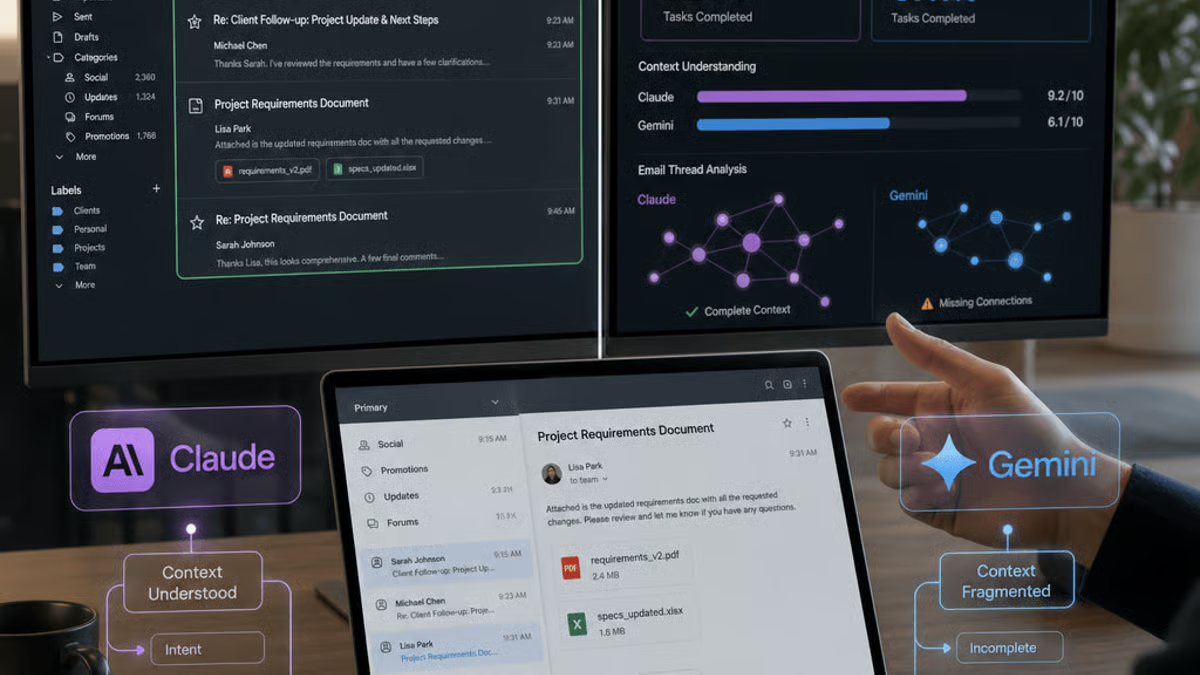
In a head-to-head test of AI email assistants, Anthropic’s Claude Cowork successfully completed a complex research task that left Google’s Gemini struggling, according to hands-on testing from ZDNet. The real-world comparison reveals how connected AI assistants are starting to deliver on the promise of actually taming email overload – but not all of them equally.
Anthropic’s Claude Cowork just proved it can do something Google’s Gemini can’t – actually understand what you need from your messy inbox. In hands-on testing reported by ZDNet, the AI assistant tackled a nuanced research task that required sifting through Gmail messages to identify specific pitches, extract relevant quotes, and locate permission confirmations. Gemini choked on the same assignment.
The test wasn’t about simple keyword searches or basic categorization. It required the kind of contextual judgment humans make dozens of times daily – understanding intent, recognizing relevant information across different message formats, and connecting related threads without explicit markers. Claude Cowork handled it. Gemini didn’t.
This matters because the AI assistant market has been drowning in demo videos and benchmark scores while users still can’t get their AI to do genuinely useful work with their actual data. Google has been pushing Gemini’s integration across Workspace for months, positioning it as the native advantage in productivity AI. But when a third-party assistant like Claude Cowork outperforms Google’s own AI inside Gmail, it raises questions about whether platform ownership actually translates to better AI performance.
Anthropic launched Claude Cowork as part of its broader push into enterprise productivity, competing directly with Microsoft’s Copilot integrations and Google’s Workspace AI features. The product connects Claude’s language models to email, calendar, and document systems – essentially giving the AI read access to your work context so it can handle multi-step tasks that require understanding your specific situation.
The email research test exposed a critical difference in how these AI systems handle ambiguity and context. Finding the right pitch email isn’t just matching the word “pitch” – it requires understanding tone, recognizing business context, and distinguishing between different types of messages. Extracting usable quotes means identifying which passages actually answer the user’s need, not just pulling any quoted text. Locating permission confirmations demands recognizing implied consent and formal approvals across varied phrasings.
Google built Gemini with massive scale and deep integration into its ecosystem, yet Claude Cowork – operating as a connected third-party tool – delivered better results on this practical task. The performance gap suggests Anthropic’s architecture choices around reasoning and context handling may be paying off in real-world applications, even without platform advantages.
This isn’t the first time Claude has shown strength in complex reasoning tasks. The model has consistently performed well on benchmarks requiring multi-step logic and contextual understanding. But benchmark performance and actual utility have often diverged in AI products. Plenty of impressive models fail at mundane real-world tasks because they can’t bridge the gap between test scenarios and messy user data.
For Google, the comparison stings. The company has been positioning AI as central to its future across Search, Workspace, and Cloud. Gemini was supposed to be the engine powering smarter productivity tools that leverage Google’s unmatched data access. When an external AI does better work inside Gmail than Google’s own assistant, it undermines that entire positioning.
The broader implication hits the whole productivity AI market. We’re past the point where companies can sell AI assistants on potential. Users are testing these tools with real work, and the ones that actually save time will win regardless of whose ecosystem they live in. Microsoft faces the same pressure with Copilot – integration alone won’t keep users if the AI can’t deliver on practical tasks.
Email overload has been a promised AI use case for years. Early attempts at smart inbox sorting and automated responses mostly failed because they couldn’t handle the nuance of human communication. Claude Cowork’s success on this research task suggests we might finally be reaching the capability threshold where AI can genuinely help – but only if the underlying model has the reasoning chops to handle ambiguity and context.
The competitive dynamic is shifting fast. Anthropic is moving aggressively into enterprise deals, OpenAI is pushing ChatGPT Enterprise with data connections, and Google and Microsoft are both racing to prove their integrated AI actually works better than third-party alternatives. Users are becoming the ultimate judge through direct comparisons like this email test.
What happens next depends on whether Google can close the capability gap or if Anthropic can scale its advantages into broader enterprise adoption. For now, the message is clear – in the AI assistant wars, being built into the platform doesn’t guarantee being the best at using it.
The showdown between Claude Cowork and Gemini on email research isn’t just about one test or one feature – it’s a signal that the AI productivity race is entering a new phase where actual performance on messy real-world tasks matters more than integration advantages or benchmark scores. As users get hands-on access to multiple AI assistants, they’re discovering that platform ownership doesn’t automatically mean better AI. For enterprises evaluating productivity AI investments, this comparison suggests it’s worth testing multiple options against actual workflows rather than assuming the native choice will perform best. The assistant that genuinely saves time on your specific tasks will win, regardless of whose logo is on it.




Leave a Reply