
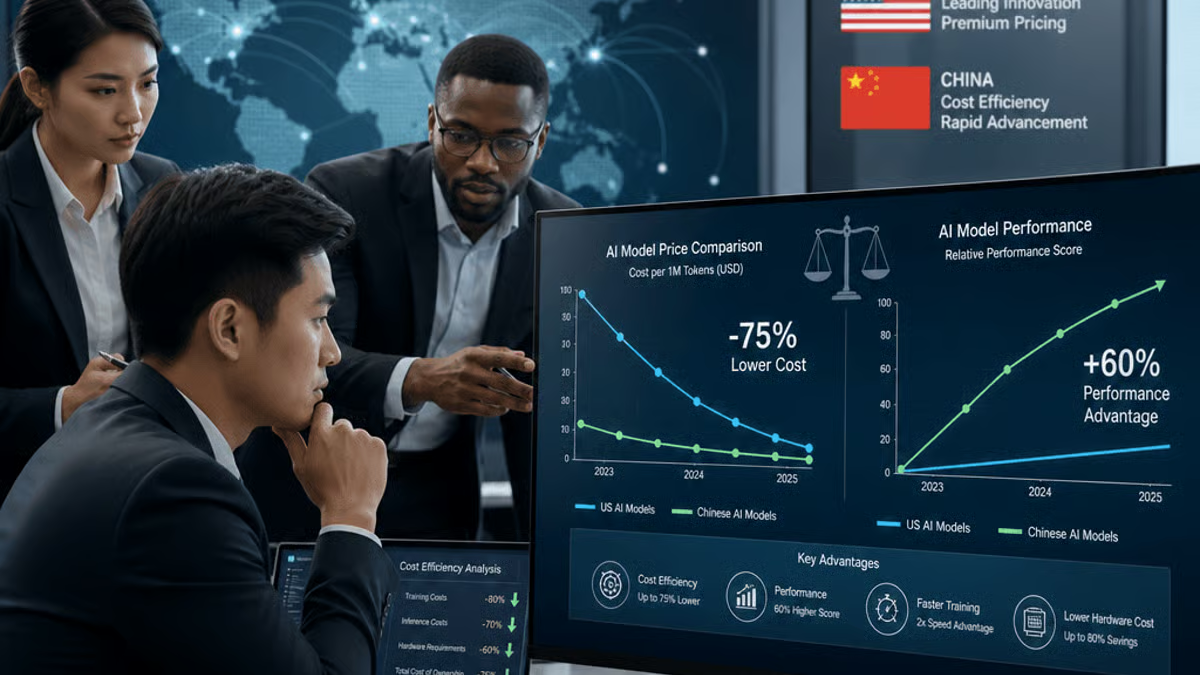
American companies are quietly switching to Chinese AI models as the cost of running OpenAI and Anthropic systems becomes unsustainable. New releases from DeepSeek and Z.ai are matching the performance of leading U.S. frontier models while undercutting them on price, marking a significant geopolitical shift in the AI landscape that’s catching American providers off guard. The migration signals a new phase in the global AI race where cost efficiency trumps country of origin.
The AI market just hit an inflection point that nobody in Silicon Valley saw coming. U.S. companies are migrating to Chinese large language models at an accelerating pace, and the reason is simple: they can’t afford not to.
OpenAI and Anthropic have dominated enterprise AI deployment for the past two years, but their pricing models are starting to crack under competitive pressure from an unexpected direction. Recent releases from Chinese AI companies including DeepSeek and Z.ai are delivering performance that rivals GPT-4 and Claude at a fraction of the cost, according to CNBC reporting.
The competitive dynamics are stark. While OpenAI charges premium rates for API access to its flagship models, Chinese alternatives are coming in at price points that make them impossible for cost-conscious enterprises to ignore. Companies running high-volume AI workloads are seeing their inference costs drop by 60-80% when they switch providers, creating a compelling financial argument that’s overriding concerns about geopolitical risk.
This isn’t about inferior knockoffs anymore. DeepSeek‘s latest model release demonstrates capabilities that many developers consider comparable to leading U.S. frontier systems across key benchmarks. Z.ai’s offerings are gaining traction in specific enterprise use cases where cost per token matters more than marginal performance gains. The technical gap that American AI labs relied on as their moat is narrowing faster than expected.
The shift comes at a particularly challenging moment for U.S. AI leaders. OpenAI is navigating massive infrastructure costs as it scales its computing capacity, while Anthropic faces pressure to justify its multibillion-dollar valuation with sustainable unit economics. Both companies have raised prices over the past year, but that strategy is backfiring as alternatives emerge.
Enterprise procurement teams are taking notice. Companies that built their AI strategies around OpenAI or Anthropic APIs are now running parallel evaluations of Chinese models, testing whether they can maintain application quality while slashing infrastructure spend. Early results are encouraging enough that some are committing to full migrations.
The geopolitical implications are significant. U.S. policymakers spent the past two years implementing export controls designed to slow China’s AI development by restricting access to advanced chips. But Chinese companies appear to be achieving competitive results through algorithmic efficiency and architectural innovations that require less raw computing power. It’s a playbook that’s working.
Microsoft-backed OpenAI and Google-affiliated Anthropic now face a two-front war: competing on price against leaner Chinese rivals while simultaneously racing to maintain their technical edge. The comfortable position they occupied six months ago is evaporating.
Industry insiders say the pressure is forcing American AI labs to reconsider their entire go-to-market strategy. Premium pricing works when you’re the only game in town, but not when credible alternatives exist at a third of the cost. Some enterprise customers are already negotiating harder on contracts, using Chinese pricing as leverage.
The wild card is regulatory response. Will U.S. companies face restrictions on deploying Chinese AI models for sensitive workloads? So far, there’s been surprisingly little policy clarity, leaving enterprises to make their own risk calculations. Many are deciding that the cost savings are worth the uncertainty.
What’s clear is that the AI market just became genuinely global and genuinely competitive. The assumption that U.S. companies would dominate the commercial AI landscape is being tested in real time, and the results are uncomfortable for Silicon Valley. DeepSeek and Z.ai aren’t household names yet, but they’re showing up in enterprise RFPs with increasing frequency.
The next few quarters will reveal whether this is a temporary disruption or a permanent reset of the competitive landscape. If Chinese models continue improving while maintaining their cost advantage, American AI leaders will need to find new ways to justify their premium positioning beyond just technical performance.
The enterprise AI market is experiencing its first genuine competitive disruption since ChatGPT launched the current wave of adoption. Chinese models from DeepSeek and Z.ai are proving that cost efficiency can be just as disruptive as technical superiority, forcing OpenAI and Anthropic to confront a reality where their premium pricing is a vulnerability rather than a strength. For enterprises, this opens up new options and strategic flexibility. For American AI leaders, it’s a wake-up call that dominance in this market won’t come automatically. The global AI race just got a lot more interesting, and a lot more unpredictable.








Leave a Reply