
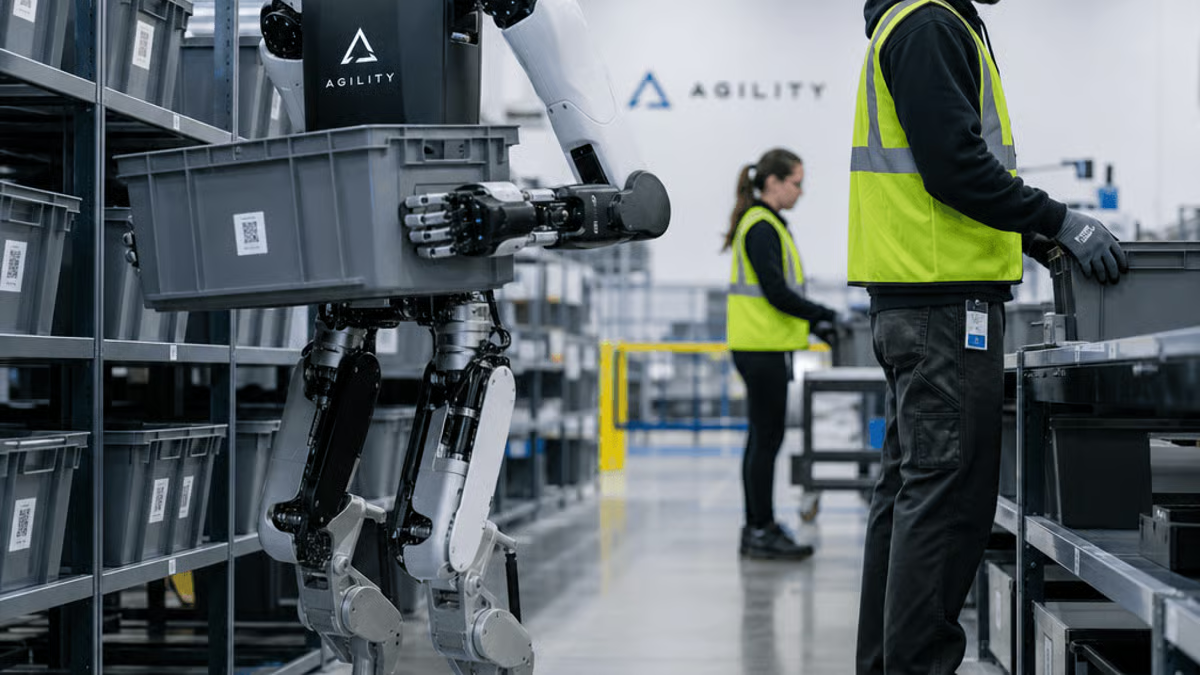
Agility Robotics, the Oregon-based humanoid robotics startup behind the bipedal Digit robot, just announced plans to go public through a $2.5 billion SPAC merger. The deal will generate $620 million in proceeds for the company, marking one of the most significant public market debuts in the robotics sector since the AI boom accelerated demand for automation. The move signals growing investor confidence in humanoid robotics as the technology transitions from research labs to factory floors.
Agility Robotics is taking the SPAC route to Wall Street, and it’s doing so with a valuation that puts humanoid robotics squarely in the big leagues. The company announced plans to merge with a special purpose acquisition company in a deal valued at $2.5 billion, with $620 million in proceeds earmarked for scaling production of its flagship Digit robot.
The timing couldn’t be more strategic. Humanoid robots have shifted from science fiction to serious business in the past 18 months, driven by breakthroughs in AI that give these machines better spatial reasoning and task flexibility. Agility has been at the forefront of this transition since spinning out of Oregon State University in 2015, when its co-founders developed the bipedal locomotion technology that became Digit’s signature capability.
Digit doesn’t look like your typical warehouse robot. Standing roughly human height with bird-like legs and articulated arms, it can navigate stairs, uneven surfaces, and tight spaces that wheeled robots can’t handle. The company’s been deploying units at logistics facilities, where Digit moves totes, sorts packages, and handles repetitive tasks that contribute to worker injuries. Amazon began testing Digit in its fulfillment centers last year, though the e-commerce giant hasn’t disclosed how many units it’s running.
The $620 million war chest addresses Agility’s most pressing challenge – manufacturing at scale. The company opened a factory in Salem, Oregon capable of producing thousands of units annually, but ramping production of complex robotics hardware requires significant capital. Each Digit unit contains sophisticated sensors, actuators, and onboard AI compute that must work in concert. Building that supply chain isn’t cheap, and the SPAC proceeds give Agility runway to iron out production economics.
SPACs fell out of favor after the 2021 boom turned to bust, with many deals failing to deliver promised returns. But robotics companies have fared better than other sectors in the post-SPAC reckoning. Investors appear willing to bet on hardware with clear use cases and revenue potential, especially when AI tailwinds suggest expanding addressable markets. Agility’s existing commercial deployments give it an edge over purely developmental robotics startups.
The competitive landscape is heating up fast. Tesla is developing Optimus, its humanoid robot that Elon Musk claims will eventually be more valuable than the car business. Figure AI raised over $650 million earlier this year with backing from Microsoft, Nvidia, and OpenAI. Boston Dynamics, now owned by Hyundai, continues iterating on Atlas. Agility’s public listing gives it permanent capital to compete with deep-pocketed rivals.
The deal structure wasn’t disclosed in initial reporting, including which SPAC is merging with Agility or the mix of cash versus equity. Those details typically emerge in SEC filings that follow announcement. What matters more is the validation – a $2.5 billion valuation suggests institutional investors believe humanoid robotics can capture meaningful market share in the multi-trillion dollar logistics and manufacturing sectors.
Agility’s path mirrors the broader maturation of the robotics industry. Early stage companies that demonstrated technical capability are now proving commercial viability. The shift from research grants and venture funding to public markets represents robotics coming of age as an investable sector, not just a futuristic bet. With labor shortages persisting across warehousing and manufacturing, and AI making robots more capable, the business case for humanoids is strengthening.
The $620 million proceeds will likely flow into three areas – scaling the Salem factory, expanding the engineering team to iterate on Digit’s capabilities, and building out the sales and deployment infrastructure needed to support enterprise customers. Robotics isn’t a winner-take-all market, but first movers with working products at scale have significant advantages in securing marquee customers and refining their technology through real-world feedback.
Agility’s SPAC debut marks a pivotal moment for humanoid robotics – the technology is moving from lab demos to balance sheets. The $2.5 billion valuation won’t seem outlandish if Digit and its competitors can deliver on the promise of flexible automation that adapts to human environments. For investors, the bet is straightforward: labor costs keep rising, AI keeps improving, and robots that can navigate our world without rebuilding it for them will capture massive market share. The next 24 months will determine whether that thesis plays out or if humanoids remain a niche solution searching for scale. Either way, Agility just gave the public markets a front-row seat to find out.






Leave a Reply